Legal Notice Ka Process in India: Steps, Deadlines and Next Moves
Know what to include, how to send it, when special deadlines apply, and what to do if payment still does not arrive.

Table of Contents
Table of Contents
Swipe →Your refund is pending, your security deposit has not come back, or someone who promised to repay you has stopped responding. It is frustrating, especially when you are not sure whether a legal notice is necessary or what it should say. The good news is that the process is manageable when you take it one step at a time. This guide explains how to prepare and send a legal notice in India, which deadlines need special care, and what you can do if the other person still does not pay.
First, what does a legal notice actually do?
A legal notice is a formal written demand. It tells the recipient what went wrong, what you want them to do, and when you expect a response. It also creates a clear record that you raised the issue. It is not a court order, and sending one does not automatically make the other person pay.
Suppose an online seller took payment but never delivered your order. You may already have asked for a refund through customer support. A notice brings the order details, payment proof, previous requests and exact refund demand together in one document. The same approach can help when a landlord withholds a deposit or a friend does not repay money you transferred. If you want a fuller explanation before you start, read what a legal notice means in India.
Do you have to send one before filing a case?
Usually, not for an ordinary refund or unpaid-money claim. There is no universal rule requiring everyone to send a notice and wait 15 days before filing. A notice is often useful because it gives the other side a documented chance to resolve the dispute, but you should not mistake a common practice for a legal requirement. Cheque-bounce complaints and certain suits against the government have specific notice rules, covered below.
Nor does a notice pause every filing deadline. If your claim is already old, check the applicable time limit before spending weeks revising drafts or sending repeated reminders. The useful question is not simply, “Can I send a notice?” It is, “Will this notice clearly state my claim and leave me enough time to take the next step?”
Get your amount and proof straight before drafting
A strong notice starts with records, not forceful language. If you cannot explain why ₹12,000 is due rather than ₹10,000, the recipient can use that uncertainty to avoid a clear answer. Work out the principal amount, any refund already received, and each deduction you dispute. Ask for additional amounts only when you have a basis for them, and keep the calculation separate from the story of what happened.
Gather the material that would let a stranger understand the transaction. A written agreement helps, but its absence does not mean you should give up. Payment records, order confirmations and messages can help establish what was promised. For money lent informally, a bank transfer plus chats discussing repayment may be important; see this guide to recovering money without a written agreement.
What to keep | Why it matters |
|---|---|
Order, invoice, agreement or booking confirmation | Shows the parties, price and promised product, service or repayment terms. |
Bank statement, receipt or UPI transaction ID | Connects your payment to the transaction and supports the amount claimed. |
Messages, emails and earlier complaints | Shows promises, delays, refund requests and the recipient’s replies. |
Notice copy, postal receipt and delivery tracking | Shows what you demanded and helps establish when and where you sent it. |
Put the documents in date order. Write down the promised delivery or repayment date, the date you first complained, and any partial payment. If this is a rental deposit dispute, keep the rent agreement, move-out communication and photographs relevant to disputed deductions. If it is a consumer refund, keep screenshots of the order status and refund policy as they appeared when you placed the order.
Finally, verify whom you are addressing. A shop’s trading name, a company’s legal name and an individual seller may not be interchangeable. Use the invoice, agreement or business correspondence to identify the right recipient and a verifiable address. A carefully drafted notice sent to the wrong person or an unverified address may create avoidable problems later.
What should your notice say, and how do you write it?
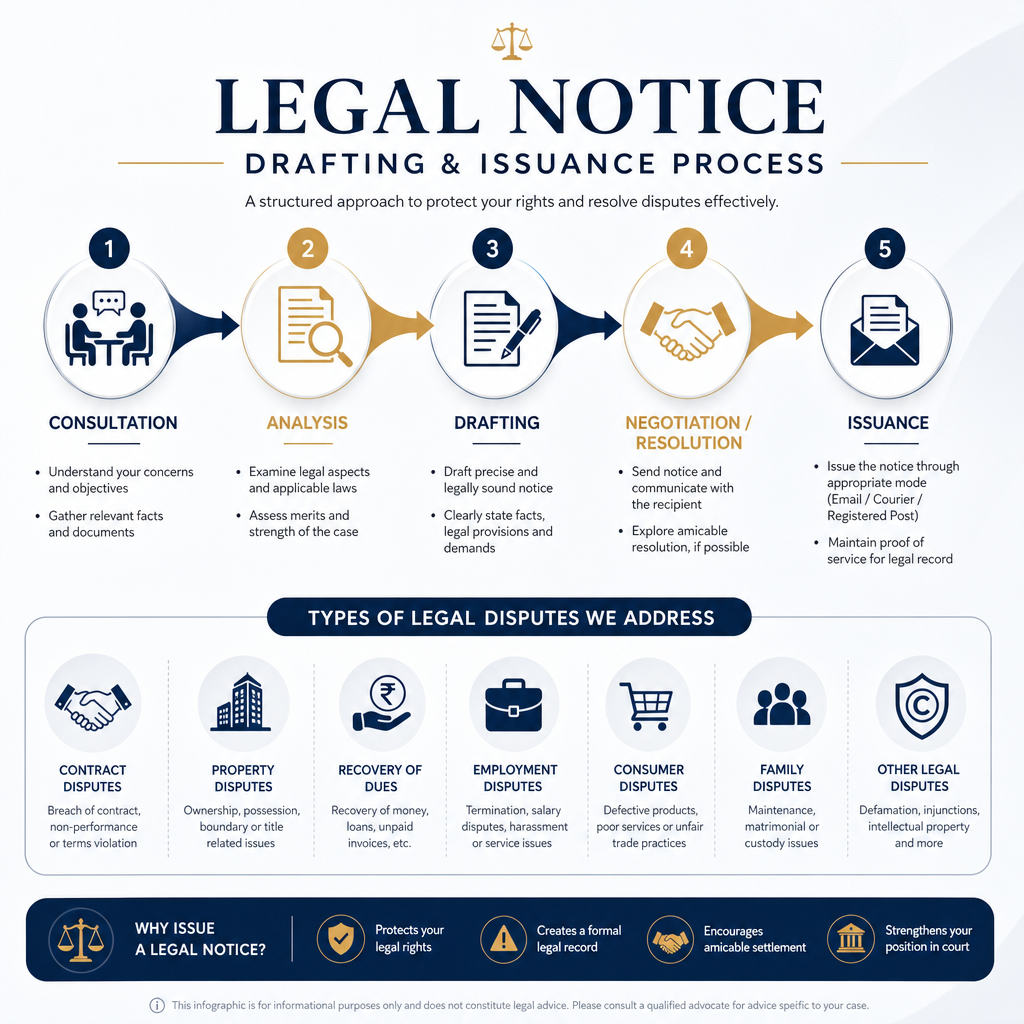
You do not need dramatic legal language. The reader should be able to understand, in one reading, what happened and what would settle the matter. A clear notice is more useful than pages of accusations. For a closer look at layout, use this legal notice drafting checklist while preparing yours.
Identify both sides. Include your name and contact details, the recipient’s correct name and address, and the date of the notice.
Describe the transaction. State when you paid or lent the money, what was promised, and the order, invoice or agreement reference.
Explain the failure. Say what was not delivered, refunded or repaid. Include relevant dates and mention earlier attempts to resolve it.
State the exact demand. Give the amount, a simple calculation, and the action you want, such as a refund to your original payment method.
Set a response deadline. Choose a reasonable date for a reply or payment, subject to any specific legal timetable that applies.
State your next step accurately. Say that you may use the appropriate complaint or legal route if the matter remains unresolved. Do not threaten action you cannot or do not intend to take.
Make the demand easy to verify
Imagine you paid ₹8,000 for a service, received ₹2,000 back, and want the balance. “Refund my money” leaves room for argument. “Refund the outstanding ₹6,000, calculated as ₹8,000 paid less ₹2,000 already returned” does not. Attach or refer to the payment records and the message confirming the partial refund. If you seek an additional amount, explain its basis rather than slipping it into the total.
Keep the tone firm and civil. You can say that payment was due on a particular date and remains outstanding. You do not need to call the other person a fraudster because they missed that date. If you suspect an online financial fraud rather than an ordinary non-payment dispute, do not wait for a notice: alert your bank and report it immediately through 1930 or cybercrime.gov.in.
A lawyer can help where the facts, recipient or deadline are disputed, and professional review is especially sensible for a cheque-bounce notice. But an ordinary consumer refund does not automatically require a lawyer-drafted notice. The essential task is to get the facts, demand and proof right.
Visual Dispute Resolution & Recovery Framework
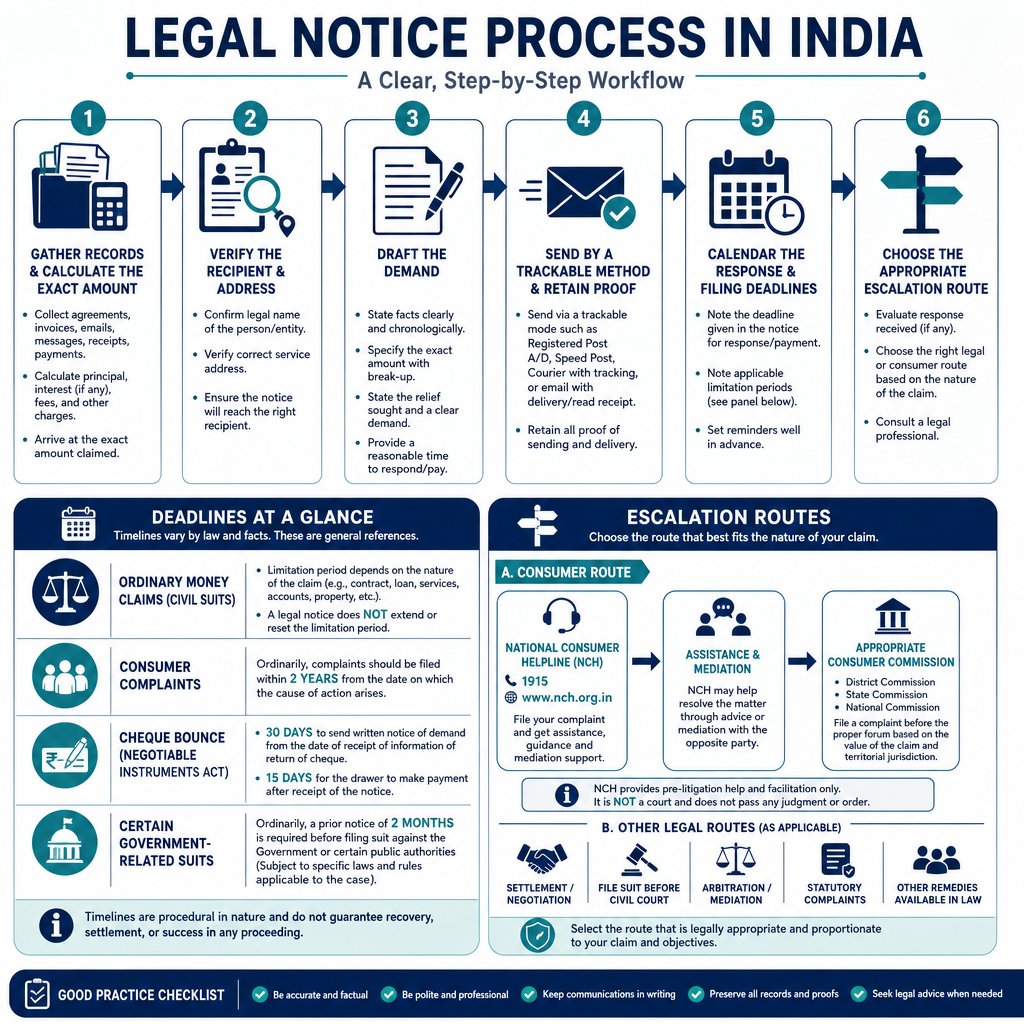
How do you send it and prove it reached the right place?
Once the wording is final, save a dated copy exactly as sent. Address it using the best verified details you have, then send it through a trackable method. Speed Post or registered post is commonly used because the receipt and tracking record help show dispatch and delivery. Keep both; a photograph of the envelope alone is not a substitute.
Email can provide an additional record, particularly when you have used that address for the transaction. Preserve the sent message, attachments and any reply. But do not assume a WhatsApp “seen” tick or an email alone will satisfy every special statutory notice requirement. The safest delivery choice depends on the type of claim and the evidence you can retain. This guide to ways to deliver a legal notice explains the practical options.
What if the letter comes back?
Do not throw away a returned envelope. Keep it with the postal endorsement and tracking record. Check whether the address was incomplete, the recipient moved, or another delivery issue arose. Then verify the address again before deciding whether to resend or seek advice. If your deadline is close, deal with that urgently rather than assuming a second attempt will protect your claim.
After dispatch, make one folder containing the signed or final notice, attachments, postal receipt, tracking screenshots, email copy and any response. If payment arrives, keep proof of the amount and confirm in writing whether it settles the whole claim or only part of it. A phone call may be encouraging, but a written record prevents fresh confusion.
Which deadlines can change the process?
For an ordinary demand, you may set a reasonable response period. That does not mean every recipient gets a legally required 15 days, or that you can file whenever you like afterwards. The underlying claim has its own limitation period. Different rules also apply to certain types of notice.
Situation | Deadline or rule to check | What it means for you |
|---|---|---|
Many unpaid-loan, invoice or contract claims | The relevant Limitation Act claim commonly has a three-year period, but the starting date varies. | Find out when your right to sue arose. Sending a notice alone does not restart the clock. |
Consumer complaint for defective goods or deficient paid services | Section 69 of the Consumer Protection Act, 2019 ordinarily requires filing within two years of the cause of action. | Do not let notice exchanges use up your filing time. |
Cheque bounced against a legally enforceable debt | A written demand under section 138 must be made within 30 days of receiving bank dishonour information. The drawer then has 15 days from receiving it to pay. | If unpaid, the Magistrate complaint ordinarily must be filed within one month after the cause of action arises. |
Suit against government or a public officer for an official act | Section 80 of the Code of Civil Procedure generally requires two months’ prior notice; urgent-relief cases have a court-permission route. | Get advice before treating this like an ordinary private payment dispute. |
For a cheque bounce, the dates are statutory, not a suggested schedule. Keep the cheque, bank return memo, demand notice and delivery proof together. If this is your situation, follow the cheque-bounce notice timeline rather than relying on the response period you might use for a refund request.
For ordinary money claims, even a correct notice does not itself extend limitation. A qualifying signed acknowledgment or part-payment can affect limitation under the Limitation Act, but whether it does so depends on the facts and timing. If the transaction is old, check the time limit for a money recovery case promptly. Do not assume that another reminder buys more time.
What happens if the deadline passes without payment?
Silence is unpleasant, but it does not leave you with only one option. First, check the delivery record and your response deadline. Then review any reply carefully. The recipient may deny the amount, offer a partial refund, or ask for documents. Answer genuine factual points in writing, but do not enter an endless cycle of fresh notices while a filing deadline approaches.
Choose the next route based on the dispute, not on how strongly worded the notice was:
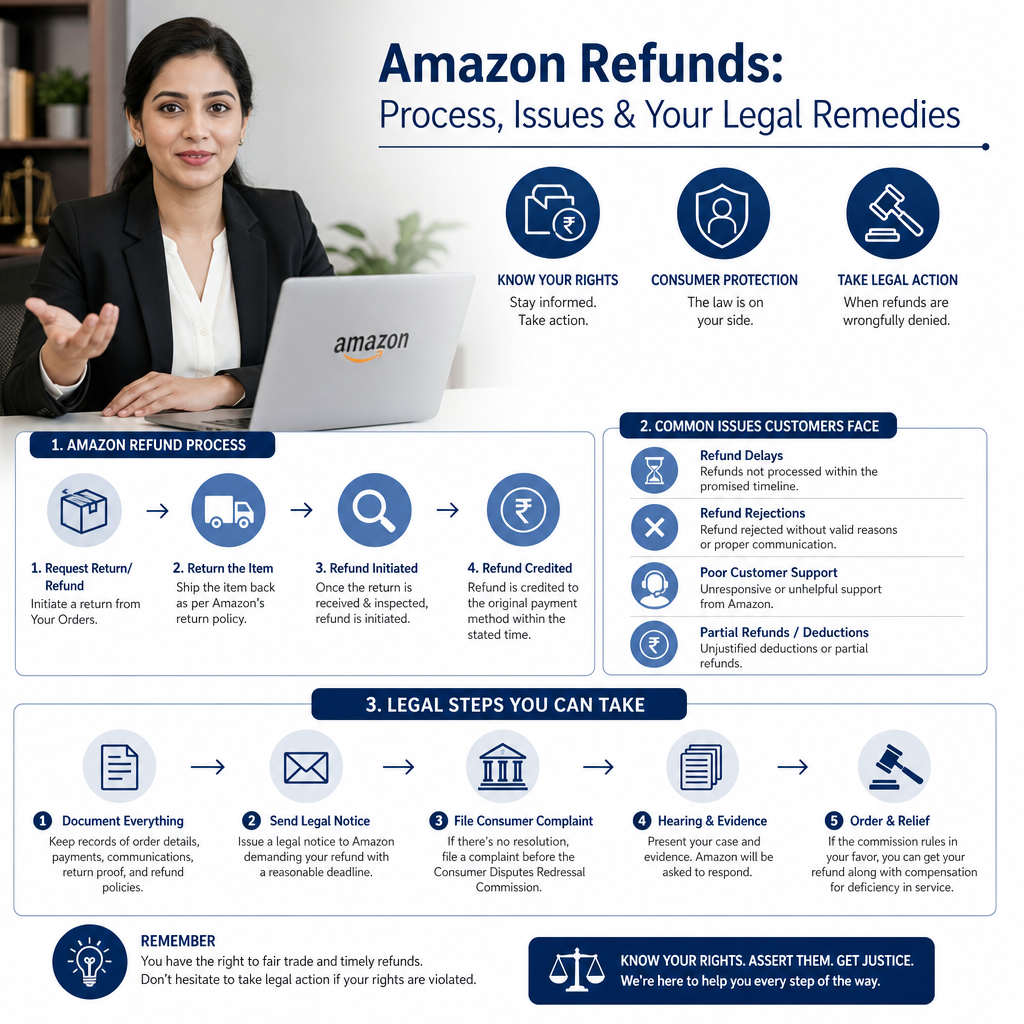
Purchase or paid-service refund: Complain to the business first. You can then seek pre-litigation help from the National Consumer Helpline at consumerhelpline.gov.in or 1915. If unresolved, the appropriate consumer commission can be approached through e-jagriti.gov.in. NCH assistance is not a court judgment.
Personal loan or other documented private dues: Review the repayment evidence and applicable limitation period, then consider a suitable civil recovery route with legal advice where needed.
Rental security deposit: Use your agreement, payment proof, move-out record and any explanation of deductions to decide whether a further written response or formal claim is appropriate.
Consumer commissions are selected by the amount paid for the goods or services, not simply by the compensation you demand. Under the applicable jurisdiction rules, the District Commission handles amounts paid up to ₹50 lakh, the State Commission handles amounts above ₹50 lakh up to ₹2 crore, and the National Commission handles amounts above ₹2 crore. If you are unsure how to start, this consumer complaint guide walks through that route.
Be realistic about timing. Preparing a straightforward notice may take a few days; receiving payment depends on the other side. Consumer law sets disposal goals of three months after the opposite party receives notice, or five months if product testing is needed, but those are goals, not guaranteed completion dates. If your notice is ignored, focus on the next useful step rather than sending the same demand indefinitely. You can also read what to do after an ignored legal notice.
A manageable plan for this week
Start today by making a one-page timeline and gathering your proof. Tomorrow, confirm the recipient’s name and address and calculate the amount still due. Draft a short notice, check whether a special deadline applies, and send it through a method you can track. Put the response date and any filing deadline in your calendar. These small steps turn an unclear problem into a record you can act on.
If you would rather have help drafting and following up, LegalRecovery offers an online process for unpaid-money matters such as consumer refunds, rental deposits and personal dues. You submit your case online, legal experts review it, a professional notice is drafted and dispatched by registered post, and follow-up and escalation can be managed online. Its flat-fee pricing starts at ₹1,499; a notice or paid service cannot guarantee recovery. You can see how LegalRecovery’s process works before deciding whether it suits your case.
Most importantly, you do not have to solve the entire dispute in one sitting. Your first job is to state a provable demand, send it carefully, and know when to move on. That is what makes a legal notice useful: not the threat of one, but the clear path it gives you towards your next decision.
Popular Searches & Related Topics

Legal Recovery is India's trusted consumer protection and legal tech platform. We specialize in holding corporations accountable for unfair trade practices, deceptive marketing, and commercial fraud. With over 15,000 customers counselled, our mission is to provide fast, out-of-court resolutions by connecting you with top-tier panel advocates for immediate legal action.
Client Reviews
"I was waiting for a refund after an online order was not delivered. LegalRecovery helped organise my order details and payment proof into a clear notice, and explained how it would be sent and tracked. The seller responded and processed the refund. I appreciated the straightforward updates."
Ananya Mehta
"My landlord had not returned my rental security deposit after I moved out. LegalRecovery helped set out the deposit amount and move-out details in a formal notice and guided me on keeping the delivery record. The communication was clear, and the deposit issue was resolved."
Rohit Sharma
"A client had left several freelance invoices unpaid, and my follow-ups were going nowhere. LegalRecovery reviewed the invoice and message records and helped send a professional demand. I was happy with the organised process and the client later paid the outstanding amount."
Priya Nair
"I had lent money to a friend and had bank transfer records and messages about repayment, but was unsure how to make a clear demand. LegalRecovery helped me present the amount and repayment history in a formal notice. The service was responsive and made the next steps easier to understand."
Vikram Patel
Frequently Asked Questions
Related Articles
About Author
Team LegalRecovery
View ProfileTeam LegalRecovery is a dedicated team of legal and financial professionals specializing in loan settlement, banking disputes, debt relief, and corporate compliance. We are committed to helping clients achieve debt freedom and business stability through expert strategic advisory.
Connect on LinkedInNeed Legal Help?
Get expert advice on loan settlement, banking disputes and debt relief.
Start Recovery NowRequest Callback