Legal Notice for Cheque Bounce: A Complete Guide
Learn how to draft an effective legal notice for cheque bounce.
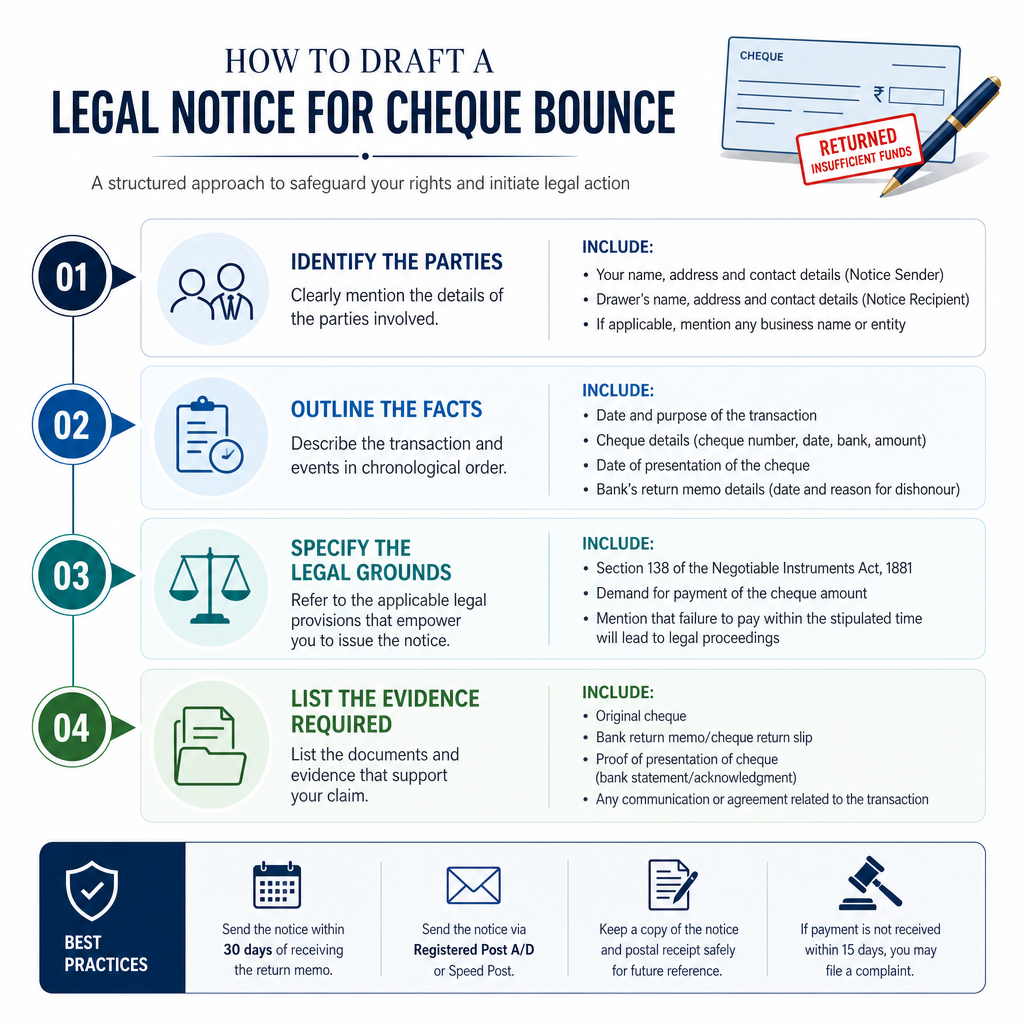
Table of Contents
Table of Contents
Swipe →Mastering the Legal Notice for Cheque Bounce: Your Comprehensive Recovery Guide Under Section 138 of the NI Act
When a business transaction, personal loan repayment, or vendor settlement involves a cheque, there is an implicit trust that the document represents real, accessible currency. However, when that commercial promise fails and your bank issues a cold, clinical "Cheque Return Memo," that trust shatters. A bounced cheque is more than just an administrative inconvenience; it disrupts cash flow, stalls operations, and can severely impact financial stability. If you are dealing with a defaulted payment, it is crucial to understand that Indian law provides a powerful, time-bound mechanism to protect your interests.
The first and most critical milestone in this recovery process is the drafting and delivery of a formal legal notice for cheque bounce. Governed strictly by Section 138 of the Negotiable Instruments Act, 1881 (NI Act), this statutory notice serves as an explicit warning to the drawer. It formally demands the clearance of the outstanding debt within an unyielding timeline. Missing or mishandling this initial procedural step can invalidate your entire claim, letting a defaulting debtor escape liability on simple technicalities.
Navigating the intersection of financial disputes and criminal liability requires meticulous precision. At Legal Recovery, we specialize in guiding individuals, freelancers, entrepreneurs, and corporate entities through the exact steps needed to transform a broken promise into a legally enforceable recovery action. This deep-dive article provides the actionable insights, strict statutory timelines, structural requirements, and strategic nuances necessary to successfully issue a legal notice for cheque bounce and reclaim what is rightfully yours.
Understanding Section 138 of the Negotiable Instruments Act
In India, a cheque bounce is not merely a civil breach of contract; it is a criminal offense. To protect the credibility of banking channels and commercial transactions, the legislature introduced Section 138 into the Negotiable Instruments Act. This section establishes a clear framework: if a person issues a cheque to discharge a legally enforceable liability and that cheque is returned unpaid by the bank, it constitutes an offense punishable by up to two years of imprisonment, a monetary fine extending up to twice the cheque amount, or both.
[Cheque Deposited] ──> [Dishonoured by Bank] ──> [30-Day Window to Send Legal Notice] ──> [15-Day Payee Waiting Period] ──> [30-Day Window to File Court Complaint]
However, the criminal mechanism under Section 138 does not trigger automatically the moment a cheque fails. The law mandates a strict sequence of conditions that must be fulfilled before a magistrate can take cognizance of the offense. The foundation of this entire criminal prosecution rests on the timely and accurate serving of a legal notice for cheque bounce. If the payee fails to issue this demand notice within the window prescribed by law, the door to criminal prosecution shuts permanently, leaving you with only lengthy, expensive civil remedies.
Why a Legal Notice for Cheque Bounce is Mandated by Law
The legal notice for cheque bounce is not an optional courtesy; it is a strict statutory prerequisite. The law provides this mechanism to give an honest drawer a fair opportunity to rectify an inadvertent error—such as a sudden administrative delay or a temporary mismatch in funds—before being subjected to a criminal trial.
From a strategic perspective, serving a well-crafted legal notice achieves several vital objectives:
Establishes Criminal Intent: It officially documents that the drawer has been informed of the dishonour, transforming a transactional failure into a conscious default if they choose to ignore it.
Saves Time and Litigation Costs: A significant percentage of cheque bounce disputes are settled during the mandatory 15-day notice period. When a debtor realizes that a criminal trial is imminent, they often clear the dues immediately to safeguard their personal liberty and corporate reputation.
Preserves Your Rights across Jurisdictions: A validly served notice locks in the timeline, ensuring your right to approach the appropriate Magistrate Court within the strict 30-day limitation window if compliance is not met.
The Step-by-Step Procedure for Managing a Bounced Cheque
Successfully recovering money from a dishonoured instrument requires moving through a series of consecutive, time-sensitive phases. The table below outlines the core progression of a standard recovery action.
Phase | Milestone Action | Governed By | Statutory Timeline | Critical Requirement |
1 | Cheque Presentation | Section 138, Proviso (a) | Within 3 months of the date written on the cheque face | Must be presented while the instrument is legally valid. |
2 | Receipt of Return Memo | Bank Notification | Day Zero for the Payee | The bank must specify a valid reason (e.g., "Insufficient Funds"). |
3 | Issuing Legal Notice | Section 138, Proviso (b) | Within 30 days from receiving the Cheque Return Memo | Must formally demand the exact cheque amount in writing. |
4 | Statutory Waiting Window | Section 138, Proviso (c) | 15 days from the date the drawer receives the notice | The drawer must be allowed this full period to clear the debt. |
5 | Filing Criminal Complaint | Section 142(1)(b) | Within 30 days after the 15-day waiting window expires | Filed before a Metropolitan or Judicial Magistrate of the First Class. |
Core Components of an Enforceable Legal Notice
A legal notice for cheque bounce must be drafted with absolute precision. Any ambiguity, mathematical error, or missing statutory element can be exploited by defense counsel to have a future court complaint dismissed.
An unassailable notice must explicitly contain the following details:
1. Proof of a Legally Enforceable Debt
The notice must clearly articulate the underlying transactional relationship between the payee and the drawer. You must state exactly why the cheque was issued—whether it was for the recovery of salary and employment dues, outstanding business invoices, or resolving ongoing property and builder disputes. Under the NI Act, cheques issued as pure gifts or for unlawful considerations do not qualify for protection under Section 138.
2. Precise Instrument Details
The notice must itemize the structural facts of the cheque. This includes the exact cheque number, the specific date inscribed on the instrument, the issuing bank, the branch location, and the precise monetary amount down to the paisa.
3. Presentation and Dishonour Details
You must document the exact date you deposited the cheque into your bank account and the precise date your bank returned it. The official reason cited on the Cheque Return Memo—most commonly "Funds Insufficient" or "Exceeds Arrangement"—must be stated verbatim.
4. The Unconditional 15-Day Demand
The concluding paragraphs must contain an explicit, unconditional demand calling upon the drawer to pay the exact sum of the bounced cheque within 15 days of receiving the notice.
Critical Drafting Rule: The notice must explicitly demand only the exact principal amount of the dishonoured cheque to satisfy the criminal requirements of Section 138. While you can mention separate civil claims for interest or legal fees elsewhere in the text, mixing these amounts into the primary statutory demand can invalidate the notice.
Standard Structural Format for the Legal Notice
To ensure your notice meets all statutory benchmarks, it should follow a clear, professional legal structure. Below is an authoritative, industry-standard draft layout used by seasoned legal practitioners.
STATUTORY DEMAND NOTICE UNDER SECTION 138 OF THE NEGOTIABLE INSTRUMENTS ACT, 1881
BY REGISTERED POST A.D. / SPEED POST
Date: 06/06/2026
To, [Name of the Defaulting Drawer/Debtor]
[Complete Residential or Corporate Address]
[City, State, Pin Code]
Subject: Legal Notice under Section 138 of the Negotiable Instruments Act, 1881 for the dishonour of Cheque No. [Cheque Number] for INR [Amount in Figures]/-.
Sir/Madam,
Under instructions from and on behalf of my client, [Your Name / Company Name], residing at/operating from [Your Address], hereinafter referred to as my 'Client', I hereby serve you with this statutory legal notice for cheque bounce as detailed below:
That you approached my Client for [specify the underlying transaction, e.g., the procurement of commercial goods, a short-term personal loan, or settlement of vendor invoices]. In consideration of this transaction, you admitted your clear financial liability towards my Client.
That in discharge of your legally enforceable debt and financial liability, you issued a cheque bearing Cheque No. [Number] dated [DD/MM/YYYY] drawn on [Drawer's Bank Name and Branch] for an amount of INR [Amount in Figures]/- (Rupees [Amount in Words] Only) in favor of my Client.
That my Client presented the said cheque for encashment through their banker, [Payee's Bank Name and Branch], within its period of statutory validity. However, my Client was shocked to receive an official Cheque Return Memo dated [DD/MM/YYYY] from the bank, returning the cheque unpaid with the explicit endorsement/reason: "Funds Insufficient".
That you issued the aforementioned cheque with full knowledge that your bank account lacked the necessary funds to honor the instrument, revealing a clear intention to deceive and cause wrongful financial loss to my Client.
Therefore, by means of this statutory legal notice, I hereby call upon you to pay the entire cheque amount of INR [Amount in Figures]/- (Rupees [Amount in Words] Only) to my Client within fifteen (15) days from the date of your receipt of this notice.
Please note that if you fail to clear the entire outstanding amount within the stipulated 15 days, my Client has given me mandatory instructions to initiate criminal prosecution against you under Section 138 of the Negotiable Instruments Act, 1881. This can result in stringent penalties, including criminal imprisonment for up to two years, a fine up to double the cheque amount, or both. My Client will also pursue appropriate civil remedies to recover all associated costs, interest, and damages entirely at your risk and consequence.
A copy of this notice is retained in my office for future legal reference.
Yours faithfully,
[Advocate's Signature & Stamp]
For and on behalf of [Payee Name]
Common Reasons for Cheque Dishonour
While an insufficiency of funds is the most common trigger for a cheque bounce, several other banking reasons can lead to a dishonour that falls within the criminal scope of Section 138.
┌────────────────────────────────────────────────────────┐
│               COMMON DISHONOUR REASONS                 │
├───────────────────────────┬────────────────────────────┤
│ 1. Funds Insufficient     │ 3. Account Closed          │
│ 2. Signature Mismatch     │ 4. Stop Payment Ordered    │
└───────────────────────────┴────────────────────────────┘
Funds Insufficient: The ledger balance in the drawer's account is lower than the amount written on the cheque.
Signature Mismatch: The drawer's signature on the cheque does not match the specimen signature registered with their bank. Courts interpret an intentional signature variance as a deliberate attempt to stall payment, which satisfies the criteria for criminal liability.
Account Closed: The drawer issues a cheque from an account that they subsequently or previously closed. This is viewed by courts as an outright act of bad faith.
Stop Payment Instructions: The drawer instructs their bank to halt payment on an issued cheque without a valid, legally justifiable reason. If this instruction is used simply to avoid paying a legitimate debt, it constitutes a clear offense under Section 138.
Crucial Timelines and the Pitfalls of Limitation
In cheque bounce litigation, time is your most critical asset. The Negotiable Instruments Act operates on strict, non-negotiable limitation windows. Missing a single deadline by even 24 hours can destroy your criminal case, forcing you to seek costlier and slower alternate legal remedies.
The 30-Day Notice Window
The moment your bank hands you the Cheque Return Memo, a strict 30-day countdown begins. You must draft, finalize, and dispatch the legal notice for cheque bounce within this specific window. If the 30th day passes and the notice has not been dispatched via a verifiable postal channel, you forfeit your right to file a criminal complaint under Section 138 for that specific presentation instance.
The 15-Day Cure Window
Once the legal notice is delivered to the drawer, the law steps back to give them a 15-day waiting period to cure the default. You cannot file a court case during these 15 days. Doing so makes the complaint premature, leading to an immediate dismissal by the magistrate. The cause of action to file a formal court complaint matures only on the 16th day.
The 30-Day Filing Window
From the day the 15-day cure window expires, you have exactly 30 days to present a formal written complaint before the competent Magistrate Court under Section 142 of the NI Act. If you fail to file within this month-long window, you must submit a separate application to condone the delay, which requires proving extraordinary, unavoidable circumstances to the satisfaction of the judge.
Statutory Recovery Metrics & Resolution Benchmark
Disputes resolved via formal statutory legal demand notices.
Average statutory compliance response timeline.
Mandatory refund of statutory levies under Indian Acts.
Interest compensation claimable under MSME & NI Acts.
Tactical Contexts: Tailoring Your Recovery Strategy
Cheque bounce issues appear across many different sectors, each requiring a tailored tactical approach to maximize your chances of recovery.
Commercial and Corporate Defaults
In business-to-business transactions, a bounced cheque frequently points to deeper operational or cash flow strains. When a corporate entity issues a dishonoured instrument, Section 141 of the NI Act introduces the principle of vicarious liability. This means you can prosecute not just the company itself, but also its managing directors, working partners, and key officers who were directly responsible for managing the business when the cheque was issued. Highlighting this personal criminal liability in your notice often accelerates settlements during corporate vendor and invoice recoveries.
Real Estate and Construction Disputes
In the real estate sector, homebuyers frequently receive post-dated cheques from developers as assured returns, delay compensation, or refunds for canceled bookings. When these high-value cheques bounce, it usually highlights systemic financial distress or systemic bad faith by the builder. Issuing a swift legal notice for cheque bounce works alongside claims filed under the Real Estate Regulatory Authority (RERA) or consumer forums, adding strong criminal leverage to resolve complex property and builder disputes.
Personal Loans and Informal Commitments
Recovering funds from an acquaintance or family friend requires balancing professional legal firmness with personal relationships. Individuals often hesitate to act, allowing critical limitation periods to expire. However, a bounced cheque provides definitive written proof of an obligation. Serving a formal notice promptly clarifies that the matter is handled professionally, making it highly effective for the recovery of money from a friend before the assets vanish.
The Gig Economy and Freelancer Rights
Freelancers, independent consultants, and creative professionals regularly face long delays or outright non-payment from clients. When a client finally issues a cheque that subsequently bounces, it can cause severe financial stress. A formal statutory notice quickly levels the playing field, compelling non-compliant clients to prioritize the recovery of freelancer and client payments ahead of other unmonitored liabilities.
How to Handle a Bounced Cheque: A Definitive Visual Guide
To successfully navigate the recovery process without making procedural errors, follow this step-by-step operational workflow.
STEP 1: SECURE DOCUMENTATION
Collect the original cheque, the Bank Return Memo, and all underlying invoices or contracts.
       │
       ▼
STEP 2: ENGAGE PROFESSIONAL LEGAL COUNSEL
Connect with a specialized recovery platform like Legal Recovery to draft an unassailable notice.
       │
       ▼
STEP 3: DISPATCH VIA VERIFIABLE POST
Send the notice via Speed Post or Registered Post AD within 30 days of the Return Memo's date.
       │
       ▼
STEP 4: TRACK POSTAL DELIVERY
Monitor the tracking status on the India Post portal and save the official delivery confirmation.
       │
       ▼
STEP 5: MONITOR THE 15-DAY WAIT PERIOD
Wait for the drawer to pay. If they fail to comply, immediately transition to filing a court case.
Defensive Strategies: How to Respond to an Unjust Notice
If you find yourself on the receiving end of a legal notice for cheque bounce, you must act immediately. Ignoring a statutory notice is highly risky; it allows the complainant's claims to stand uncontested in the early stages of court review, which can lead to a quick issuance of criminal summons against you.
An effective, strategic response involves several key steps:
Dispute the Legally Enforceable Debt: If the cheque was issued as an unearned advance, a security deposit for an unfulfilled contract, or was lost or stolen, you must clearly state this position in an official reply notice within the 15-day window.
Highlight Material Alterations: If the payee filled in unauthorized amounts or dates on a blank security cheque without your consent, this constitutes a material alteration that can invalidate the instrument under Section 87 of the NI Act.
Document Past Settlements: If you already cleared the underlying debt through online bank transfers or cash payments but the payee failed to return your security cheque, you must present full documentary proof to defeat the criminal presumption of an active liability.
Recent Jurisprudential Trends and Supreme Court Clarifications
The Supreme Court of India actively refines cheque bounce jurisprudence to speed up case resolutions and prevent the judicial system from becoming gridlocked by delayed trials.
Post-Conviction Compounding Permitted
In the landmerk decision of Parsharvanath Weld Wires Pvt. Ltd. v. State of Chhattisgarh (2026), the Supreme Court reaffirmed that offenses under Section 138 are fundamentally compensatory rather than punitive. The Court ruled that even after a conviction has been finalized and the accused has begun serving a prison sentence, the offense can still be compounded under Section 147 of the NI Act if the complainant receives full financial restitution and consents to a settlement. This ruling highlights that the primary goal of the law is economic recovery, giving debtors a vital incentive to clear their debts at any stage.
The Interplay with Insolvency Moratoriums
The legal landscape is also adapting to conflicts between corporate insolvency and individual criminal liability. In cases like Dineshchand Surana v. UCO Bank (2026), the Supreme Court reviewed whether personal insolvency proceedings under the Insolvency and Bankruptcy Code (IBC) pause ongoing Section 138 criminal trials. While an IBC moratorium pauses standard civil debt collection, the courts consistently emphasize that personal criminal liabilities for dishonoured cheques continue to apply to corporate directors and individual drawers, preventing bad-faith actors from using bankruptcy as a shield against criminal actions.
The Legal Recovery Advantage: Streamlining Your Financial Restitution
Trying to manage a bounced cheque on your own often leads to frustrating delays, administrative confusion, and costly procedural mistakes. Legal Recovery simplifies this process by providing a tech-enabled, highly professional platform tailored for swift financial resolution.
┌────────────────────────────────────────────────────────┐
│               THE LEGAL RECOVERY VALUE                 │
├────────────────────────────────────────────────────────┤
│ • Expert drafting by vetted financial lawyers          │
│ • Automated tracking of strict statutory deadlines     │
│ • Transparent, fixed-fee structures with no surprises │
│ • Complete support from notice to courtroom action     │
└────────────────────────────────────────────────────────┘
When you choose to partner with us, your case follows a proven, systematic path to resolution:
Comprehensive Case Assessment: Our legal team reviews your documents to confirm the debt is legally enforceable and verify the jurisdictional facts.
Precision Legal Drafting: We draft a customized, unassailable statutory notice tailored to the unique details of your transaction.
Verified Dispatch & Tracking: We manage the secure delivery of your notice through priority postal channels, preserving ironclad proof of service for future court needs.
Seamless Transition to Litigation: If the debtor remains non-compliant after the 15-day window, our broad network of experienced trial lawyers is ready to file and manage your case in court.
We provide dedicated expertise across all areas of financial collection, including security deposits and rental recoveries, refunds and consumer complaints, and unexpected disruptions like airline and travel recoveries.
Conclusion: Take Action and Secure Your Financial Interests Today
A bounced cheque is a direct challenge to your financial stability, but the law gives you a robust, highly effective path to reclaim what you are owed. The key to a successful outcome lies in taking swift, precise action. By issuing a legally sound notice for cheque bounce within the mandatory 30-day window, you assert your legal rights, protect your business cash flow, and establish a powerful position for rapid recovery.
Do not let stalling tactics or confusing legal procedures cost you your hard-earned money. Partnering with a specialized platform ensures your recovery strategy is handled with complete accuracy, closing the gaps that debtors use to escape their obligations.
If you are holding a dishonoured cheque and need to start the recovery process, visit our About Page to learn more about our commitment to financial justice. Explore our complete range of specialized services on our Services Page, check our operational processes on How It Works, or stay updated on the latest financial laws by reading our Blog.
Take the first step toward reclaiming your funds right now. Contact our specialized team today through our Contact Page to schedule an expert case evaluation and set up a precise, unassailable recovery strategy.
Popular Searches & Related Topics

Legal Recovery is India's trusted consumer protection and legal tech platform. We specialize in holding corporations accountable for unfair trade practices, deceptive marketing, and commercial fraud. With over 15,000 customers counselled, our mission is to provide fast, out-of-court resolutions by connecting you with top-tier panel advocates for immediate legal action.
Client Reviews
"Legal Recovery provided exceptional service in helping me draft a legal notice for a cheque bounce. Their attention to detail and understanding of the law made the process seamless."
Ashok Kumar
"I was impressed by the professionalism and expertise of the Legal Recovery team. Their comprehensive guide on cheque bounce legalities was incredibly helpful."
Priya Sharma
"The clarity and precision in drafting my legal notice were top-notch. Legal Recovery's services ensured that I was fully compliant with the legal framework."
Rajesh Menon
"I highly recommend Legal Recovery for their thorough understanding of cheque bounce laws. Their support was invaluable in navigating the legal process."
Neha Patel
"Legal Recovery's expertise made a significant difference in my cheque bounce case. Their strategic approach and guidance were instrumental in achieving a favorable outcome."
Vikram Singh
Frequently Asked Questions
Related Articles
About Author
Team LegalRecovery
View ProfileTeam LegalRecovery is a dedicated team of legal and financial professionals specializing in loan settlement, banking disputes, debt relief, and corporate compliance. We are committed to helping clients achieve debt freedom and business stability through expert strategic advisory.
Connect on LinkedInNeed Legal Help?
Get expert advice on loan settlement, banking disputes and debt relief.
Start Recovery NowRequest Callback