Landlord Not Returning Your Security Deposit? What to Do
Know what to document, how to question deductions, and where to seek help under your state's tenancy rules.

Table of Contents
Table of Contents
Swipe →You have moved out, returned the keys, and need your security deposit for your next home. Instead, your landlord is delaying, has stopped replying, or has announced deductions you do not understand. That is stressful, especially when you are unsure whether to keep asking or take formal action. Start with a clear record of the handover and the amount owed. This guide explains what to collect, how to question deductions, what to write to your landlord, and where to seek help if the money still does not arrive.
First, work out what your landlord actually owes
A deposit dispute is easier to address when you can separate the amount paid from the amount that should come back. Find your rental agreement and read the clauses on the deposit, notice period, repairs, utility bills and move-out. Then write down four figures: the deposit you paid, any amount already returned, deductions you accept, and the balance you are claiming.
Check the agreement, but do not stop there
The agreement matters, but a line saying the landlord may “forfeit the deposit” does not automatically settle every disagreement. Under sections 73 and 74 of the Indian Contract Act, 1872, compensation for a breach and a stated penalty have legal limits. If the landlord claims you broke a term, ask what happened, which term applies and how the amount kept was calculated. A local lawyer can assess a contested clause against the facts.
Also check whether rent was due up to the date you gave back possession. A deposit is not automatically a substitute for your final month’s rent. Unless the landlord agrees to adjust it, keep paying what you owe and record any agreed adjustment in writing. Our guide to security deposits and rental recoveries covers this kind of claim, including disputes involving PG accommodation.
Which state’s rules apply?
There is no single India-wide deposit cap or refund deadline for every rental. The Model Tenancy Act, 2021, is a model for states, not a rule that automatically governs your agreement. For covered premises in Uttar Pradesh, section 11 of the state’s 2021 tenancy law caps a residential deposit at two months’ rent and requires its return when the landlord takes vacant possession, after deducting the tenant’s liabilities. In Tamil Nadu, section 11 of its 2017 tenancy law generally limits the deposit to three months’ rent unless otherwise agreed, and calls for a refund within one month of vacation, less liabilities.
Those examples cannot be applied to a home in another state. Check the law that covers your premises and the terms you signed. If you are unsure whether an informal or notarised document helps prove your arrangement, read about rental agreements and notarisation rather than assuming you have no case because the paperwork is imperfect.
Put your evidence together before another conversation
You do not need a perfect file to ask for your money. You do need enough to show that you paid a deposit, moved out and have a reason to question what was withheld. Save copies now, particularly if chats or listing details could later disappear. Keep the originals and share copies when making a demand.
What to keep | What it helps establish | If you do not have it |
|---|---|---|
Agreement and deposit clause | The agreed amount, notice period and conditions for deductions | Save emails, listing details and messages discussing those terms |
Bank or UPI record, or receipt | When and how much you paid | Find messages in which the owner acknowledges receiving the deposit |
Rent and utility-payment records | Whether final dues remain | Request a written statement of the alleged outstanding amount |
Notice to vacate and replies | When you told the landlord you would leave | Preserve chats and call follow-up messages that confirm the date |
Dated photos, videos and inventory | The condition of the home at move-in and move-out | Gather inspection messages, repair requests and witness details |
Meter readings and key-handover record | Final usage and when possession was returned | Send a prompt written confirmation of the handover date |
Messages about deductions or repayment | What the landlord claims or promised to pay | After a call, send a short message recording your understanding |
Make the handover unmistakable
If you have not yet left, propose a handover date and ask the landlord to inspect the place with you. Photograph each room, fixtures and meter readings. Record the number of keys returned, the date and the person who received them. A signed acknowledgment is helpful; if one is refused, immediately send a message stating that the keys were handed over and ask the landlord to correct any detail they dispute. A witness can also help.
This matters for more than proof of cleanliness. The Transfer of Property Act, 1882, addresses a tenant’s duties concerning the premises and returning possession when the tenancy ends, subject to the applicable agreement and law. In a March 2025 Supreme Court decision, M.S. Nagabhushan v. D.S. Nagaraja, the Court rejected treating the entire ₹9 lakh deposit as a refund debt while the tenant had not handed back possession and rent or maintenance remained deductible. That was a dispute-specific ruling, not a standard deposit amount. The practical lesson is simple: do not hold on to the keys or stop paying rent merely to pressure the owner.
How do you challenge deductions without getting stuck in an argument?
Owners may point to repainting, cleaning, damage, unpaid bills or a short notice period. Some deductions may be justified; others may be unsupported or larger than the cost claimed. You do not have to choose between accepting every figure and denying that you owe anything. Ask for an itemised account and evidence for each charge.
Question each item separately
For a repair, ask what was damaged, where it was, and whether the landlord has photographs, an inspection note, an invoice or an estimate. Compare that material with your move-in and move-out records. For repainting or cleaning, ask which agreement term is being relied on and what work was actually needed. For electricity, water or maintenance, request the relevant bill, period and meter reading. If the landlord says you missed the notice period, check the clause against the date and wording of your notice.
Keep your response factual: “I agree that ₹X remained payable for electricity, but I dispute the ₹Y repair charge because the fixture was already damaged in my move-in photographs.” That is more useful than an angry exchange about whether the landlord is being fair. If several charges are unclear, ask for supporting documents before agreeing to a final balance. The approach is the same when challenging unreasonable deposit deductions more formally.
What if they say they will pay after finding a new tenant?
Ask where that condition appears in your agreement or the law that applies to your tenancy. A landlord’s cash-flow problem does not, by itself, explain how much of your deposit can be kept. State when you vacated, when possession was accepted and which dues, if any, you acknowledge. Then request a definite payment date in writing. If you agree to instalments, record each amount and due date, along with the balance still owed.
Be careful with any message saying you have received a “full and final” settlement. Before agreeing, check that the payment and deductions match what you actually accept. If only part of the deposit has arrived, acknowledge that part without casually waiving the rest.
Visual Dispute Resolution & Recovery Framework
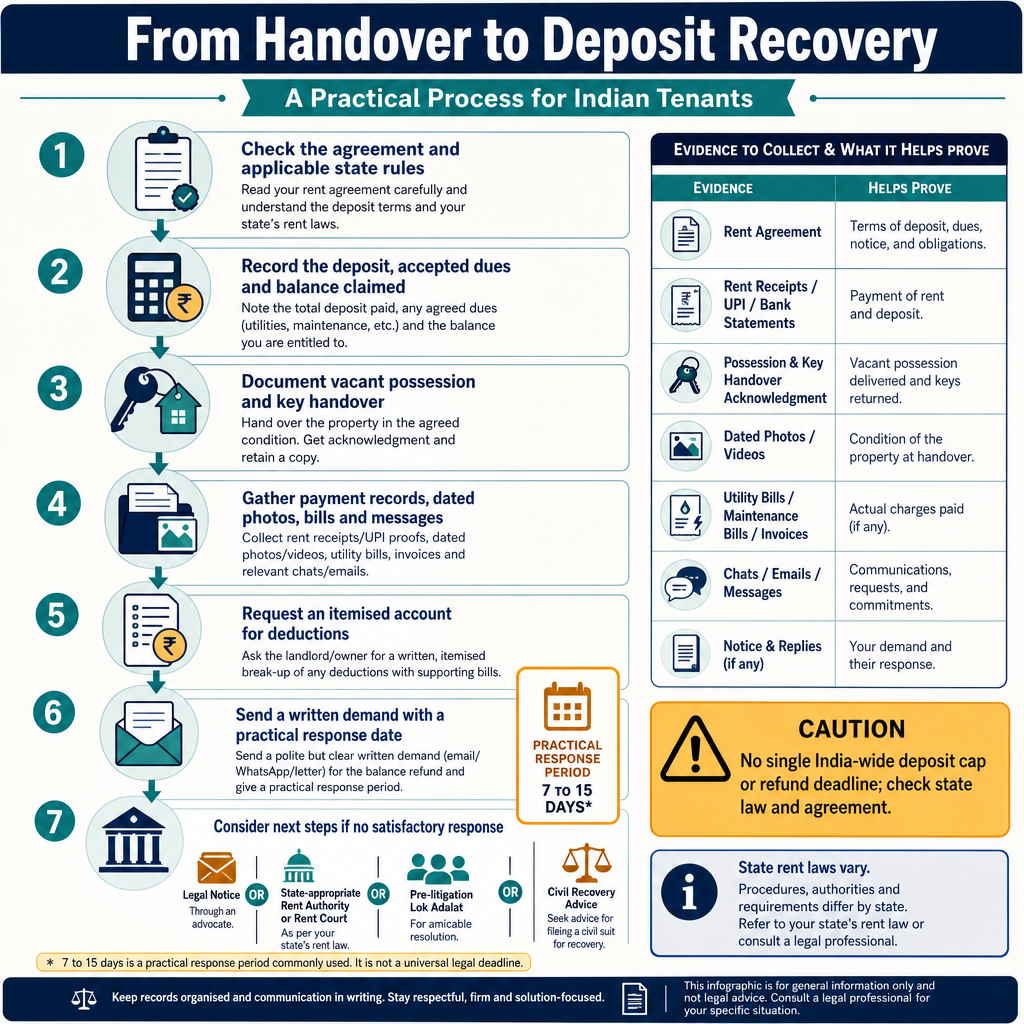
What should you do this week?
If the landlord has gone quiet, move the discussion into writing. You can be polite without leaving the request open-ended. A clear demand also gives you a record to show a mediator, lawyer or court later.
Calculate your claim. Put the deposit, payments returned and disputed deductions on one page. Do not demand the full deposit if you know rent or bills are genuinely unpaid.
Confirm possession was returned. If the handover is still pending, arrange it promptly and document it. If it has happened, state the date and how the keys were returned.
Ask for the account. Request a line-by-line list of deductions and copies of bills, invoices or other supporting records.
Send a written demand. Email or message the landlord at an address or number you have used for the tenancy. Keep a copy and proof of delivery where available.
Set a response date. Giving 7 to 15 days is a practical way to keep things moving. It is not a universal legal refund deadline or a guarantee of payment.
What should the message say?
Keep it short enough to be read. For example: “I paid a security deposit of ₹[amount] for [address] and returned possession and the keys on [date]. I have received ₹[amount] so far. Please send an itemised account, with supporting records, for any deductions and pay the outstanding balance of ₹[amount] to [payment details] by [date]. If you disagree with this calculation, please explain each difference in writing.” Change the wording if the final balance is still unknown; ask for the account and the undisputed amount first.
After sending it, avoid a stream of new messages that changes your figures or deadline. If the owner calls, note what was said and follow up in writing. You can find a more detailed deposit recovery walkthrough if you need help organising the steps around your own documents.
Will a legal notice help if a direct request fails?
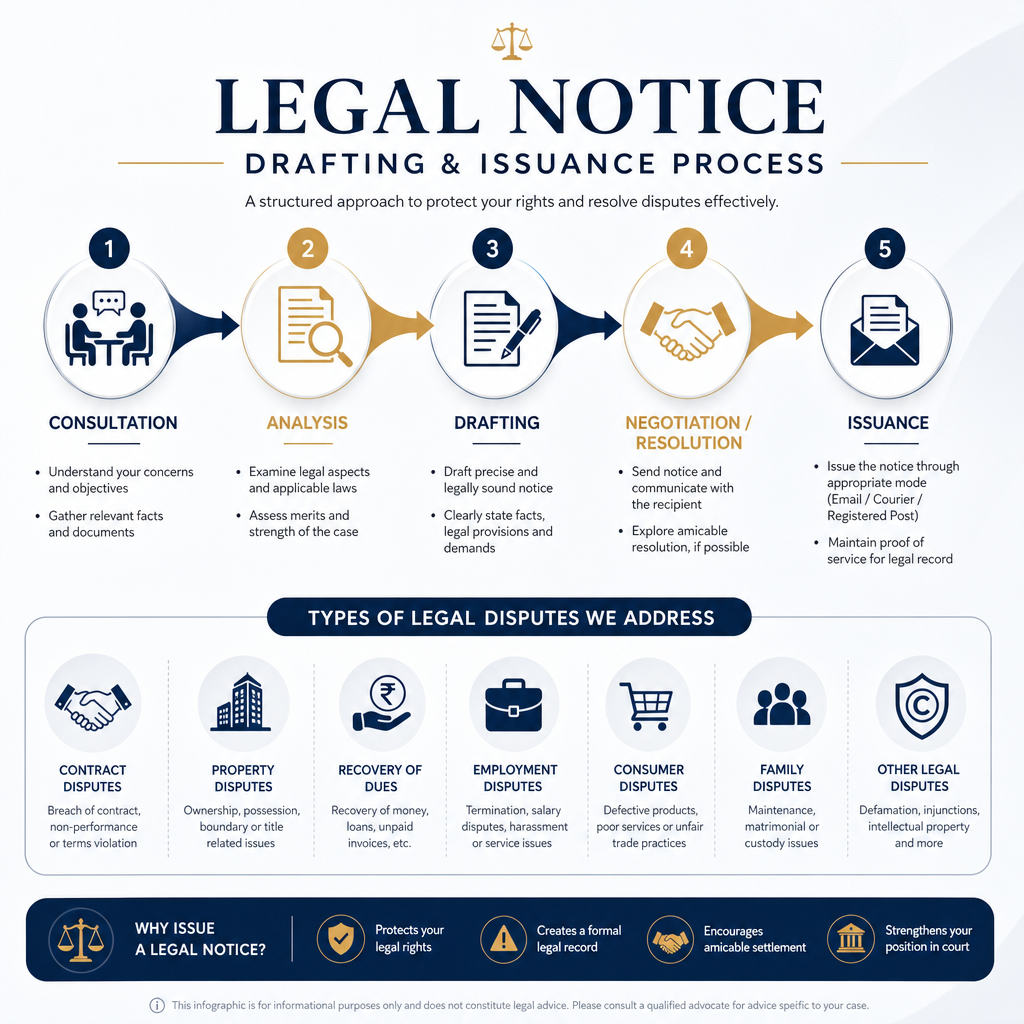
A legal notice is a formal written demand that sets out the tenancy, the deposit, the handover, the disputed deductions and the amount sought. It gives the landlord a clear opportunity to respond or settle before you consider a formal claim. It cannot force payment by itself, and sending one does not mean you have filed a court case.
A useful notice should use figures you can support. Include the agreement and payment details, the date possession was returned, any sums you accept as payable, and what evidence you have requested for the rest. Ask for payment or a reasoned reply within a stated period. Keep the dispatched copy and delivery record. If the landlord has offered a repayment date, include it and any later messages showing that it passed.
You can ask a local lawyer to prepare the notice or use an online service. LegalRecovery’s landlord deposit notice service fits this specific dispute. Its process starts with submitting the case online, followed by expert review, a professionally drafted notice sent by registered post, follow-up and escalation, and efforts toward resolution. Case management is online, with pricing starting at ₹1,499 flat fee. You can review how its process works before deciding whether it suits you. An online notice process should not be mistaken for a promise that later litigation will require no court attendance.
If the response accepts part of your claim, try to narrow the disagreement. A written agreement stating the amount and payment date is more valuable than a vague promise that the owner will “sort it out soon.”
Where can you go if the landlord still will not pay?
You do not have to begin with the most expensive option. The right forum depends on your state’s tenancy law, who you rented from and what your dispute is about. Take your agreement, payment proof, handover record and written demand when seeking advice.
Route | When it may fit | What to check first |
|---|---|---|
Rent Authority or Rent Court | Your state’s applicable tenancy law gives it power to hear the dispute | Whether your premises and claim fall within its jurisdiction |
Pre-litigation Lok Adalat through the District Legal Services Authority | Both sides may be willing to settle | Either party may request referral, but settlement requires agreement; there is no Lok Adalat court fee |
Civil money-recovery suit | Payment remains contested or the available settlement routes fail | Ask a local lawyer about the appropriate court, costs, evidence and filing time limit |
National Consumer Helpline | The dispute concerns a commercial PG operator or another provider of a consumer service | An ordinary private landlord-tenant deposit dispute should not automatically be treated as a consumer case |
For Tamil Nadu, the state tenancy website at tenancy.tn.gov.in lists its authorities and courts. Uttar Pradesh’s portal at upawas.up.gov.in is useful for tenancy registration and records; it is not, by itself, a deposit-refund complaint form. Your District Legal Services Authority can explain how to request a pre-litigation Lok Adalat referral. Civil e-filing is available in participating courts through filing.ecourts.gov.in, but check the local court’s requirements before relying on online filing alone.
If your deposit was paid to a PG operator, identify whether you dealt with a business or an individual owner; that distinction may affect your options. A PG deposit refund notice still needs the same basics: proof of payment, the agreed conditions, your exit date and a clear account of deductions. For a private rental claim that needs a court decision, read what a civil money-recovery suit involves and get advice on where to file.
How long can you wait, and how long might this take?
Send your written demand promptly, even if the landlord keeps promising to pay “next week.” The Limitation Act, 1963, can give different three-year periods to different kinds of claims. Article 22 concerns a deposit expressly repayable on demand; Article 55 concerns breach of contract. When time starts running depends on the legal basis and facts of your claim. Do not assume another reminder or notice restarts the clock. If substantial time has passed, ask a lawyer to assess limitation now. This guide to money-recovery time limits can help you prepare that conversation.
There is no reliable India-wide timeline for getting a deposit back. A documented request may resolve matters quickly if the landlord cooperates. A settlement forum depends on both sides agreeing. A contested court case can take months or years, so weigh the amount at stake, your evidence and likely costs before choosing a route. Waiting indefinitely for a replacement tenant or an unexplained repair bill is not a plan.
For now, focus on the next manageable step: document the handover, calculate the balance and ask for an evidenced account in writing. If the answer is silence or an unsupported deduction, you can move to a formal notice or suitable dispute forum with a clear record of what you are owed and why.
Popular Searches & Related Topics

Legal Recovery is India's trusted consumer protection and legal tech platform. We specialize in holding corporations accountable for unfair trade practices, deceptive marketing, and commercial fraud. With over 15,000 customers counselled, our mission is to provide fast, out-of-court resolutions by connecting you with top-tier panel advocates for immediate legal action.
Client Reviews
"My landlord kept delaying the return of my flat deposit and did not explain the deductions. LegalRecovery reviewed my documents and helped send a clear formal notice. The landlord responded with an itemised account, and we agreed in writing on the balance and payment date."
Ananya Sharma
"I was unsure how to challenge charges taken from my rental deposit. LegalRecovery helped organise my payment and handover records and prepared a professional notice. The follow-up made the request much clearer, and I received the agreed refund without having to guess what to write."
Rohit Menon
"After moving out of my PG, I was waiting for the owner to return my deposit. LegalRecovery explained what evidence to share and sent a formal demand with the amount and handover details. The owner replied and paid the amount we settled on. The online process was straightforward."
Priya Kulkarni
"My former landlord was not responding about the remaining deposit. LegalRecovery helped me present the payment proof, key handover date and disputed deductions in a structured legal notice, then followed up. The matter reached a written repayment arrangement, and I appreciated the clear communication throughout."
Vikram Reddy
Frequently Asked Questions
Related Articles

About Author
Team LegalRecovery
View ProfileTeam LegalRecovery is a dedicated team of legal and financial professionals specializing in loan settlement, banking disputes, debt relief, and corporate compliance. We are committed to helping clients achieve debt freedom and business stability through expert strategic advisory.
Connect on LinkedInNeed Legal Help?
Get expert advice on loan settlement, banking disputes and debt relief.
Start Recovery NowRequest Callback