How to Recover Unpaid Money in India Through Legal Steps
Understand notices, negotiation and escalation for unpaid salary, refunds, rent deposits, invoices and other dues.
Table of Contents
Table of Contents
Swipe →When someone owes you money, the silence can be as frustrating as the loss itself. You may be wondering whether a recovery agent can help, what they would actually do, and whether involving one will make the situation worse. The answer is simpler than it sounds: legitimate recovery work is mainly about checking the claim, contacting the other side, documenting responses and helping you take the next lawful step. This guide explains that process for unpaid salary, refunds, rental deposits and other personal or business dues, so you can decide what to do next without handing over control of your case.
What does a recovery agent actually do?
In everyday conversation, “recovery agent” can mean anyone asked to pursue an unpaid amount. For the kinds of dues discussed here, that might be a collection representative, a lawyer, or a legal-recovery service acting on behalf of the person owed money. Their job is to seek payment through communication and lawful escalation. The label does not give them a special power to take someone’s belongings, force entry, threaten them or publicly shame them.
Recovery starts with a clear claim, not a confrontation
Before contacting the person who owes you money, a competent representative should establish four things: who owes it, why it is due, how much remains unpaid, and what evidence supports that figure. An employer may agree that salary is due but dispute a deduction. A landlord may accept that a deposit must be returned but claim repair costs. If those differences are identified early, a demand can address the real disagreement instead of simply repeating “pay now.”
Next comes contact. The representative may send a written reminder, request an explanation, propose a payment date or, where appropriate, arrange for a formal legal notice. They should record what was sent, when it was delivered and how the recipient responded. If payment is offered, the amount and terms should be confirmed in writing. If the recipient disputes the claim, the representative reports that back to you rather than pretending the objection does not exist.
You remain the decision-maker. Before anyone acts for you, ask what they will do, what it costs, whether they can negotiate on your behalf and whether they need your approval before accepting less than the full amount. Never assume that handing a file to an agent guarantees recovery. Their value lies in organised follow-up, credible documentation and knowing when a dispute needs a different route.
Which unpaid amounts can follow this process?
The same broad sequence can work across different disputes, but the documents and next steps change with the relationship. If an employer has held back your final pay, start with your offer letter, payslips and exit correspondence. If a seller has promised a refund, your order record and complaint history matter more. If your former landlord has kept your deposit, the rental agreement and handover evidence become central.
For employment dues, make a written request to the employer or payroll team before escalating. Specify the months or components unpaid and ask for a calculation of any deductions. You can find more detail on recovering salary and employment dues. If you are seeking a consumer refund, keep the seller’s advertised terms, invoice, return confirmation and support replies together; the approach to refunds and consumer complaints begins with showing what was promised and what happened instead.
A rental deposit often turns on the condition of the property at move-out and the deductions permitted by the agreement. Ask for an itemised explanation, not just a verbal refusal. The guide to security deposit recovery can help you organise that conversation. Money lent to a friend needs a different kind of care: preserve messages showing that it was a loan, the amount transferred and any promise to repay. An informal arrangement can still be documented, as the guidance on recovering money from a friend explains.
These differences are why a useful recovery representative does not send the same demand to everybody. They identify the obligation, check the amount already paid and tailor the request to the facts. If you cannot yet explain your claim in a few sentences, pause before paying someone to pursue it. A short, accurate account of what happened is the foundation for every later step.
Gather the proof before anyone contacts the other side
You do not need a perfect file to begin, but you do need enough to show that the money is owed. Put the evidence in date order and keep the original messages and documents, not only cropped screenshots. This helps a representative assess the claim honestly and makes it easier to respond if the other side says the amount is wrong.
Situation | Most useful starting evidence | Question the evidence should answer |
|---|---|---|
Unpaid salary | Offer or employment terms, payslips, attendance or work records, resignation and final-settlement emails | What work was done, and which payment remains due? |
Consumer refund | Order confirmation, invoice, product or service description, cancellation or return proof, support messages | What was promised, what went wrong, and was a refund agreed? |
Rental deposit | Rental agreement, deposit receipt, move-in and move-out photos, handover messages, proposed deductions | How much was paid, and what justifies any amount withheld? |
Personal loan or other dues | Payment record, messages acknowledging the arrangement, repayment promises, receipts for partial payments | Was the payment meant to be repaid, and what is outstanding? |
Make a simple calculation alongside these records: original amount due, payments received, deductions you accept, deductions you dispute and balance claimed. If you are unsure about interest or extra charges, do not add them casually. A demand with an inflated or unexplained figure gives the recipient an easy reason to challenge it. It is better to state the sum you can support and separately ask for an account of disputed items.
Keep a contact log too. Note the date of each call or message, who spoke, what was said and any new payment date offered. Save delivery confirmations for letters and copies of emails. If a representative handles communications, ask for access to this record. It is your claim, and you should be able to see what has been done in your name.
Visual Dispute Resolution & Recovery Framework
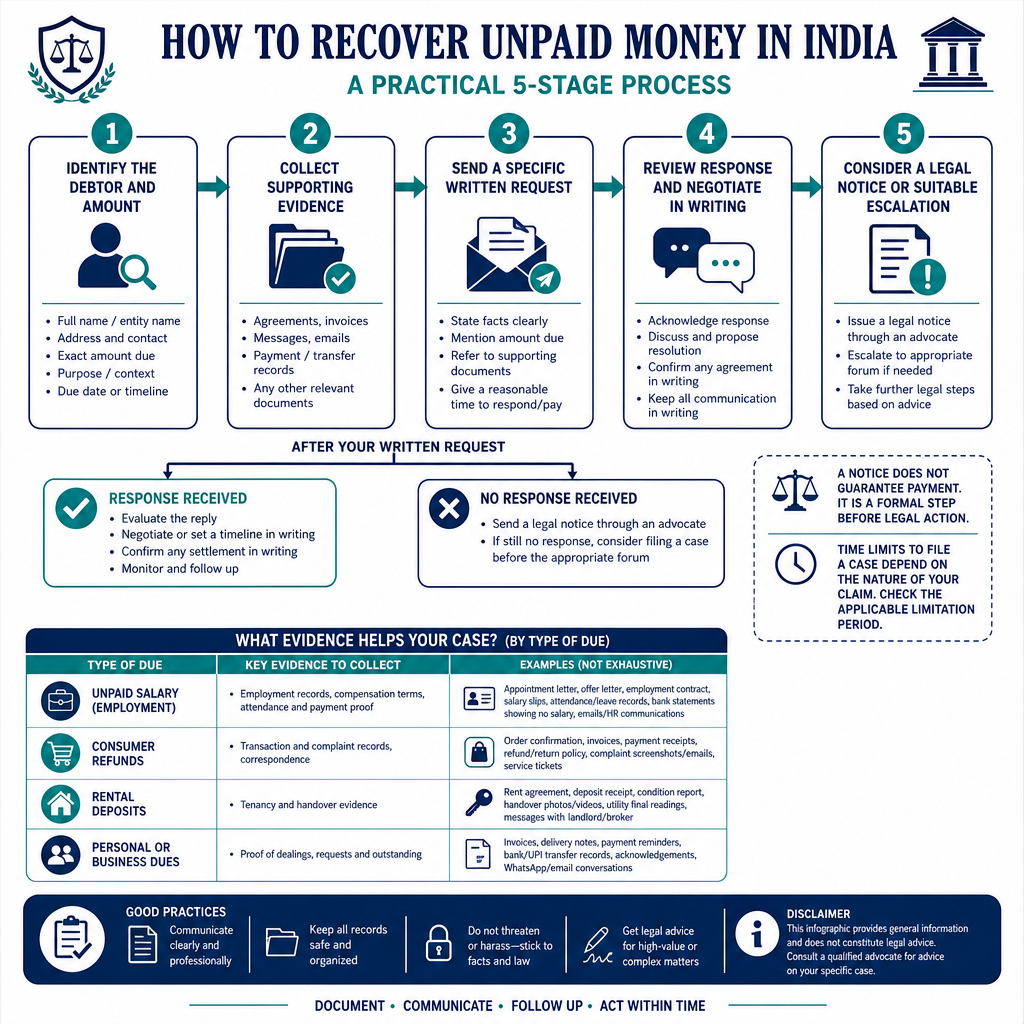
How the recovery process moves from reminder to legal notice
If you have already asked politely and received no clear answer, a structured escalation can help. It gives the other side a fair chance to respond while showing that you are prepared to pursue the matter. The point is not to sound aggressive. It is to remove uncertainty about the amount, the evidence and what you want them to do.
Step 1: Send a specific written request
Write to the person or organisation responsible for payment. State the amount, why it is due, any relevant dates and where they can find the supporting documents. Ask for payment or a written explanation by a clearly stated, reasonable date. For a salary dispute, address the employer rather than repeatedly calling an individual manager. For a refund, use the seller’s complaint channel so there is a record.
Step 2: Assess the response and negotiate carefully
A reply may reveal a fixable problem, such as a missing invoice, an incorrect account of work completed or a disagreement over damage to a rented home. Respond to the actual issue and attach the relevant proof. If both sides agree on a lower amount or instalments, record the amount, dates, method of payment and what will happen if a payment is missed. Do not describe a matter as settled until the agreed money has arrived.
Step 3: Consider a professionally drafted notice
If informal requests fail, a legal notice sets out the claim more formally and asks for payment or a response within a stated period. It can show that you are serious and may prompt a settlement, but it cannot itself compel payment. An ordinary advocate’s demand notice has no universal response deadline or guaranteed result. The deadline should be clear and reasonable for the circumstances.
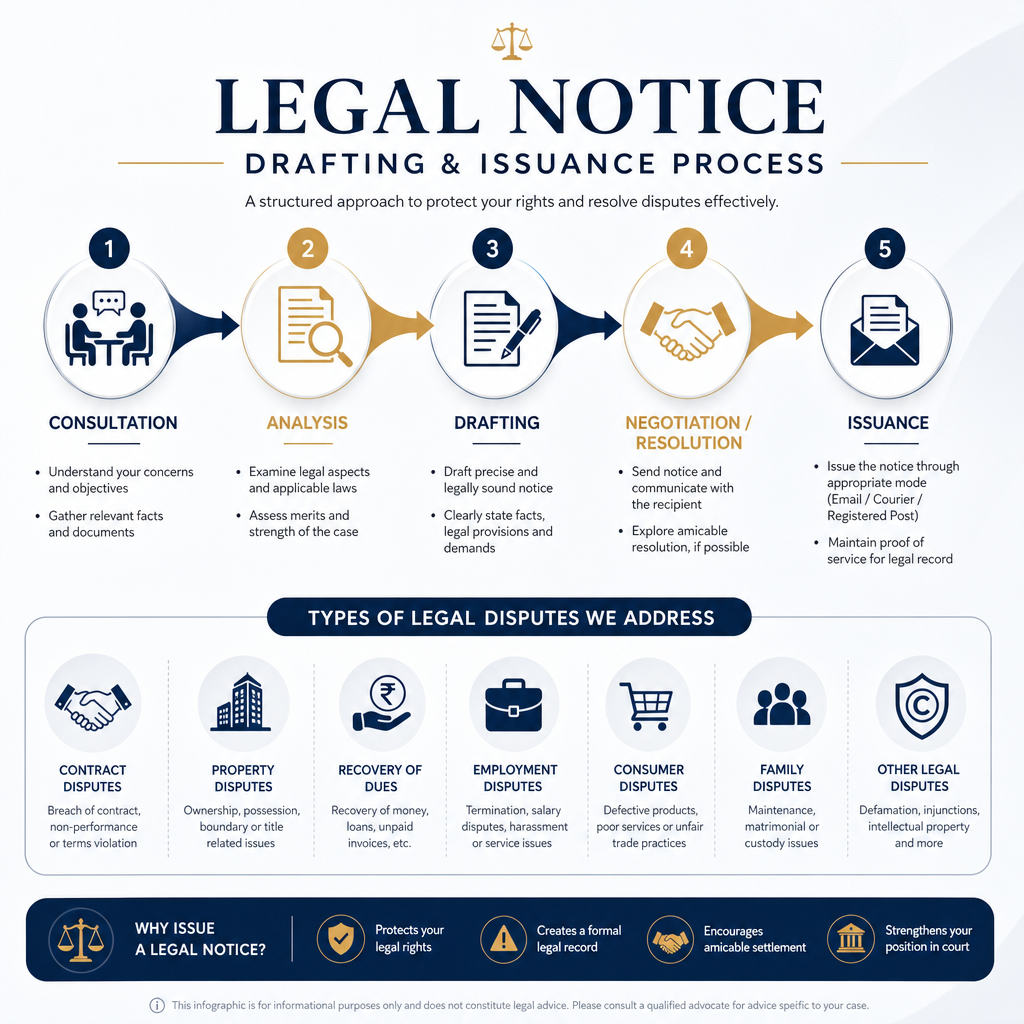
A notice should identify the parties, explain the transaction, show how the amount was calculated and say what you are requesting. It should be accurate enough that the recipient can check the claim and respond meaningfully. If you want to understand the practical drafting and delivery steps, see this guide to legal notices for money recovery. Keep a copy of the final notice and proof that it was dispatched.
Step 4: Decide what escalation is worth pursuing
Some recipients pay after a reminder; others respond only when they see a well-supported notice. Some genuinely dispute liability. At each stage, compare the amount at stake with the likely time and expense of the next step. Ask your representative for an honest assessment, including weaknesses in your evidence. Continuing to send increasingly forceful messages is not a substitute for choosing the proper complaint or legal route.
What if they still refuse to pay?
An ignored notice is disappointing, but it is not the end of the process. First check whether it reached the correct person and address. Then consider the reason for non-payment. A business that has stopped replying may call for a different approach from a landlord who has sent a detailed list of deductions. Your next step should fit the dispute, not simply repeat the demand louder.
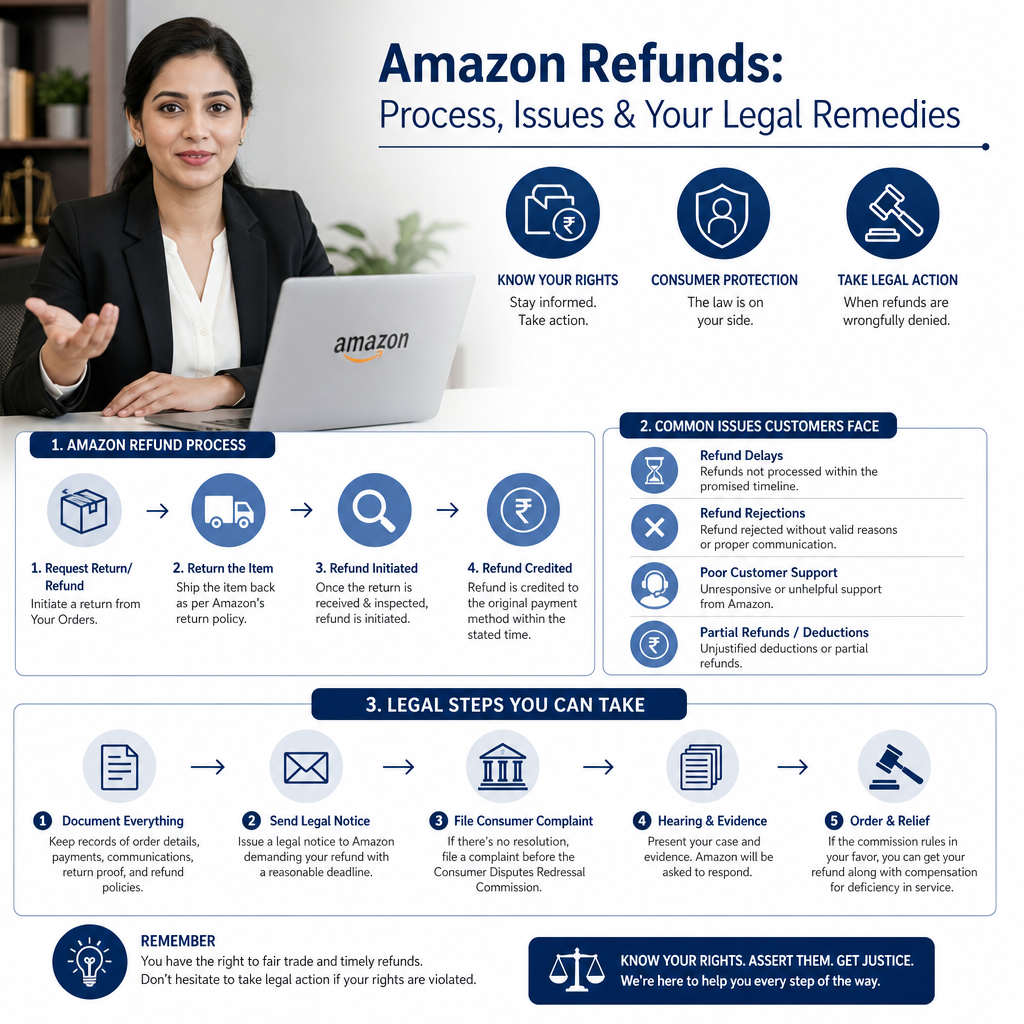
For a consumer refund, you can seek pre-litigation help through the National Consumer Helpline at consumerhelpline.gov.in or 1915. Where a service claim remains unresolved, a complaint may be brought before the appropriate consumer commission. Under the Consumer Protection Act, 2019, a deficiency in service can be the basis of a consumer complaint, and a commission can grant relief where the claim is proved. That does not mean every delayed refund automatically succeeds; your documents and the applicable terms still matter.
For other unpaid amounts, an appropriate civil remedy may be available. Where both sides are willing to agree, you can also ask the District Legal Services Authority about a pre-litigation Lok Adalat. A settlement reached there can be binding, but nobody can be forced into a compromise. If you are weighing your options after silence or refusal, this guide on what to do when a legal notice is ignored explains the next decisions.
Do not let repeated informal promises use up valuable time. Filing deadlines depend on the kind of claim and its facts, so check the applicable time limit early rather than assuming that every reminder restarts it. You can use this overview of time limits for money recovery cases as a starting point, then get advice on your particular dates. A contested case can take substantially longer than a negotiated settlement; no responsible agent should promise a quick court result.
How can you tell whether a recovery service is acting properly?
Being owed money does not justify harassment. A representative should use accurate information, identify whom they act for and communicate in a way that leaves a reliable record. They should not threaten violence, claim powers they do not have, contact unrelated people to embarrass the recipient or demand payment to an undisclosed personal account. If threats are intended to cause alarm, they may amount to criminal intimidation under section 351 of the Bharatiya Nyaya Sanhita, 2023.
Protect yourself on both sides of the transaction. If you are hiring someone, ask for written terms covering fees, the steps included, who drafts or sends notices and how you will receive updates. If someone contacts you claiming to recover a debt you supposedly owe, verify their authority directly with the person or organisation named as the claimant. Ask for a written breakdown and check it against your own receipts before paying.
Red flags include promises of guaranteed recovery, pressure to sign immediately, refusal to share a copy of communications and suggestions that public pressure will make the other person pay. A good service will tell you when your evidence is weak or the proposed cost is disproportionate. It will also seek your instructions before accepting a settlement. Professional persistence is useful; intimidation is not.
If a dispute becomes heated, keep your own messages calm and factual. You can be firm about a deadline without insulting or threatening anyone. That protects your position and gives the other side a clear opportunity to resolve the claim. If anyone uses threats or violence, preserve the evidence and contact the local police.
A practical plan for this week
You do not need to decide today whether to take someone to court. Start with a smaller goal: turn a stressful, vague problem into a documented claim and one clear request for payment.
Today: Write down who owes you money, why, how much you can prove is outstanding and when payment became due.
Next: Gather agreements, receipts, messages and earlier complaints. Put them in date order and make a separate list of anything you still need.
Then: Send one clear written request with the amount, supporting details and a reasonable response date. Keep proof of delivery.
After the deadline: Review any reply, correct genuine errors and decide whether a negotiated payment, formal notice or suitable complaint route makes sense.
If you get an offer: Confirm the settlement terms in writing and keep the payment receipt. Do not close the matter on a promise alone.
If you would rather have help organising and pursuing the claim, LegalRecovery provides an online process for the covered disputes in this article. You submit the case online, legal experts review it, a professional notice is drafted and dispatched by registered post, and follow-up and escalation continue towards resolution. Its service starts at a ₹1,499 flat fee; you can review how LegalRecovery works before deciding whether it suits your case. The service can be managed online without a court visit, though a later legal proceeding, if needed, has its own requirements.
Whether you handle the first request yourself or get professional help, the principle is the same: prove the amount, ask clearly, document every response and escalate through the right channel. Recovery agents do not recover money by force. The useful ones make a legitimate claim harder to overlook and help you choose a sensible next move if payment still does not come.
Popular Searches & Related Topics

Legal Recovery is India's trusted consumer protection and legal tech platform. We specialize in holding corporations accountable for unfair trade practices, deceptive marketing, and commercial fraud. With over 15,000 customers counselled, our mission is to provide fast, out-of-court resolutions by connecting you with top-tier panel advocates for immediate legal action.
Client Reviews
"My previous employer had not cleared part of my final settlement. LegalRecovery helped organise my payslips and exit emails, prepared a clear notice, and kept me updated on the follow-up. I appreciated having a documented process instead of making repeated calls."
Priya Sharma
"I was waiting for an online order refund and had received no useful response from the seller. LegalRecovery helped present the order and complaint history clearly in a formal notice. The communication was professional and made it easier to pursue the issue."
Rahul Mehta
"My landlord was withholding part of my security deposit without giving a proper breakdown. LegalRecovery helped me organise the rental agreement, handover messages, and photos, then guided the written follow-up. I felt informed about each step."
Ananya Iyer
"A client had delayed payment on my freelance invoice despite several reminders. LegalRecovery helped set out the invoice, work completed, and amount due in a professional notice. The process was straightforward to manage online, and I valued the clear updates."
Vikram Singh
Frequently Asked Questions
Related Articles
About Author
Team LegalRecovery
View ProfileTeam LegalRecovery is a dedicated team of legal and financial professionals specializing in loan settlement, banking disputes, debt relief, and corporate compliance. We are committed to helping clients achieve debt freedom and business stability through expert strategic advisory.
Connect on LinkedInNeed Legal Help?
Get expert advice on loan settlement, banking disputes and debt relief.
Start Recovery NowRequest Callback