Frozen Bank Account Recovery Is Outside LegalRecovery’s Scope
LegalRecovery focuses on unpaid salary, consumer refunds, deposits, invoices, and other listed money-recovery matters.
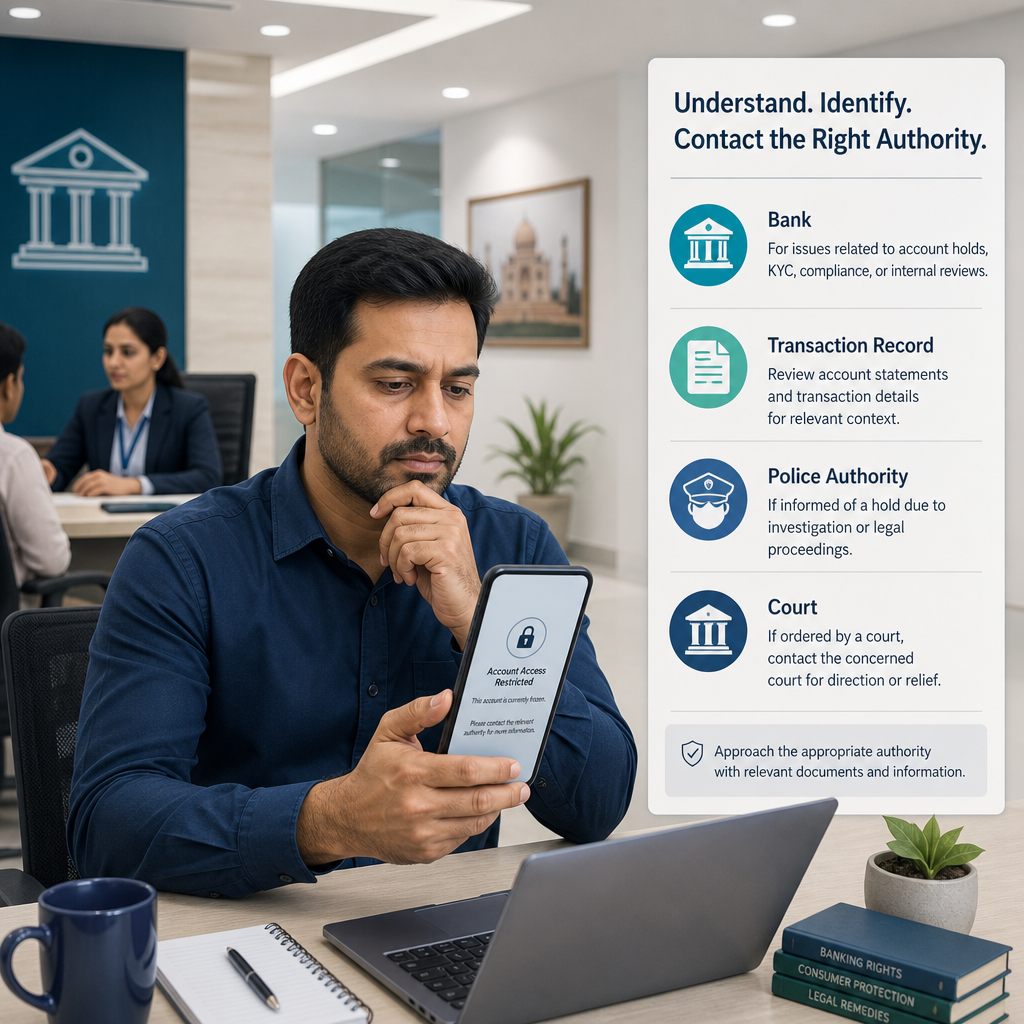
Table of Contents
Table of Contents
Swipe →Seeing your bank balance but being unable to use it is frightening, especially when bills are due and nobody has explained what happened. A frozen account does not always mean you have done something wrong, and the first step is not to send a legal notice to whoever you can find. You need to learn exactly what restriction the bank has placed, who requested it, and what that authority needs before the money can be released. This guide walks you through those steps. It also explains why frozen bank account recovery is outside LegalRecovery’s services, so you can spend your time on the route that may actually help.
First, find out what “frozen” means for your account
People use “freeze” for several different problems. Your app may show a balance but reject a transfer. A particular amount may be marked as unavailable while the rest remains usable. Or the bank may have restricted transactions because it needs updated identity documents. These situations do not have the same solution.
What you are seeing | What it may mean | What to ask the bank |
|---|---|---|
A specified amount is blocked | A lien or hold may apply to that amount. | What amount is held, which transaction is linked to it, and who requested the hold? |
You cannot withdraw or transfer anything | A debit freeze may affect the whole account. | Who directed the freeze, and can the undisputed balance be made available? |
The bank asks for updated documents | This may be a KYC-related restriction rather than a police action. | Which documents are needed, and what steps will restore account access? |
The bank refers to an investigation or order | Police, a court, or another authority may have directed the restriction. | What is the reference number, which authority issued the direction, and how can you contact it? |
Ask for the explanation in writing. A branch employee’s verbal description is useful as a starting point, but it may leave out the disputed transaction, the exact amount, or the authority you need to approach. If you are told only that the account is “under cyber hold,” ask whether the bank has placed a specific lien or stopped all debits.
The distinction matters because a bank may be able to correct its own service or documentation error, but it generally cannot disregard an external police or court direction simply because you complain. Likewise, money traced and held after your fraud complaint is not automatically yours to withdraw. Establishing a claim to its return can require action by the investigating authority or a court.
Get the bank’s written reason before choosing a remedy
Send one clear complaint to the branch and grievance officer
It is easy to lose days calling customer care and repeating the story. Put it in writing instead. Send a complaint to your branch and the bank’s grievance or nodal officer, and keep the acknowledgement. State when access stopped, what you have been unable to do, and whether the bank has identified a particular credit or debit as the reason.
Ask the bank to confirm the type of restriction, the blocked amount, the relevant transaction date and UTR or UPI reference, the name of the requesting authority, and any complaint or FIR reference it can provide. Also ask what documents the bank needs from you and what process applies to release. If the restriction followed a cybercrime complaint, ask whether the bank can submit your supported grievance through the NCRP-CFCFRMS process.
You do not need to guess the legal reason in your first message. A simple request is enough: “Please provide the written basis and scope of the restriction on my account, identify the transaction and requesting authority, and tell me how I can submit evidence and request release of the undisputed balance.” Include your account details securely, but do not post them publicly while seeking help.
Build a small, organised evidence file
Keep your ID and KYC documents, the bank’s freeze message, relevant account statements, transaction IDs, dates, amounts, and copies of every complaint and reply. If an incoming payment is questioned, add proof of why you received it: a customer order, invoice, delivery record, agreement, salary record, or messages about the transaction. Number the documents and write a short timeline so the officer reviewing them can follow the money without deciphering dozens of screenshots.
If you lost money to a scam, preserve your debit alerts, payment confirmations, screenshots, and communications with the scammer as well. Do not delete messages because they are embarrassing or because the scammer has disappeared. Your immediate task is to show what left your account, when it happened, and where you reported it.
If you lost money to fraud, report it immediately
If someone has just taken money through an unauthorised transfer or scam, do not wait for a branch appointment or a lawyer’s notice. Call the national cybercrime helpline on 1930 and complete your complaint at cybercrime.gov.in. Save the acknowledgement number. Notify your bank promptly through its official fraud-reporting channel and keep proof of when you reported the transaction.
Early reporting gives the authorities a better chance of tracing and holding funds. It does not guarantee a refund. If police identify money in another account and have it held, you may still need to establish that it relates to your loss and follow the restoration process. Ask the investigating officer what evidence is required and whether the matter needs to go before the jurisdictional court.
What if the bank says some of your stolen money has been found?
Ask for the investigating officer’s details, the complaint reference, and a clear description of where the money is held. Do not assume a screenshot showing “lien marked” means the amount will automatically appear in your account. Under the Bharatiya Nagarik Suraksha Sanhita, 2023 (BNSS), section 107 provides a court-supervised route concerning attachment and restoration of suspected proceeds of crime. Depending on how the money has been seized or held, a lawyer may advise an application concerning custody or disposal before the competent court under section 497 or 503.
If the transaction was unauthorised, also ask your bank to assess it under the RBI’s customer-liability rules for unauthorised electronic transactions. Prompt reporting can affect your liability. Those rules, including their applicable provisional-credit and resolution requirements, concern eligible unauthorised transactions; they do not turn every account freeze into an automatic bank refund.
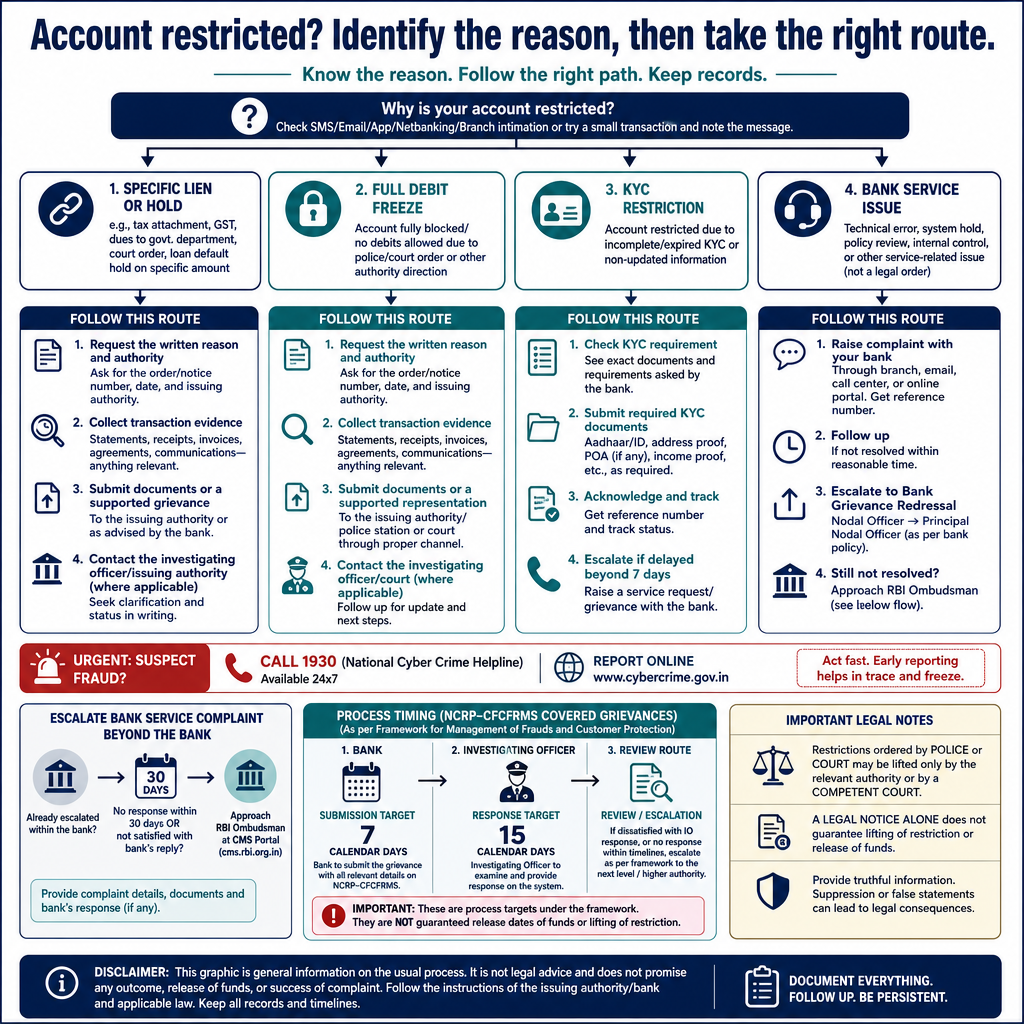
Visual Dispute Resolution & Recovery Framework
If your own account is frozen after a cybercrime complaint
A shopkeeper, freelancer, or ordinary UPI recipient can be caught in a fraud money trail because a payment reached their account. That does not, by itself, tell you whether you are accused of wrongdoing. It does mean the investigating officer may want to understand that payment. Your strongest first response is usually a transaction-by-transaction explanation supported by records, not a general statement that you have done nothing wrong.
Ask whether a narrower hold is possible
Identify the disputed incoming amount and explain its legitimate purpose. Then ask the bank and investigating authority to consider releasing the undisputed balance or replacing a blanket debit freeze with a lien limited to the relevant amount, where the facts permit. Make the request in writing and retain the response.
A Delhi High Court case decided on 20 February 2025 shows why asking is worthwhile. In Neelkanth Pharma, a company’s account with ₹93.5 crore available had been debit-frozen over a disputed ₹200 credit. Police later replaced the blanket freeze with a ₹200 lien. That is an example of a disproportionate restriction being narrowed, not a rule that every freeze must always be limited to the disputed amount. A whole-account freeze may be justified in appropriate circumstances.
Use the grievance process where it applies
For restrictions covered by the January 2026 NCRP-CFCFRMS standard operating procedure, ask your bank to lodge your supported account-holder grievance through that process. The bank is expected to submit it within seven calendar days, and the investigating officer has 15 calendar days to act or provide reasons. If the officer does not act, the matter is escalated to a district grievance officer. A dissatisfied account holder can seek review within 15 calendar days, with a further 15-day review period.
These are process targets, not promised release dates. An investigation, competing claims to the money, or a court order can make the outcome slower. Ask for the grievance reference and follow up against it rather than starting a fresh, disconnected complaint each time.
What if this is a KYC restriction or a bank service failure?
If the bank identifies overdue KYC as the problem, focus on the documents and verification it requires. Ask it to state what is missing, how to submit it, and whether any transactions should remain available while the update is processed. RBI’s June 2025 KYC amendment provides for continued transactions during a specified update period for qualifying low-risk individual customers. It does not mean every person with overdue KYC can ignore the bank’s request indefinitely.
Sometimes the problem is not the underlying restriction but the bank’s handling of it: it will not explain the reason, process your documents, or respond to a complaint. Escalate that service issue to the bank’s grievance officer first. If the bank rejects your complaint, you are dissatisfied with its response, or it does not reply within 30 days, you can consider a free complaint under the Reserve Bank-Integrated Ombudsman Scheme at cms.rbi.org.in.
Where the bank’s conduct may amount to deficient service, the Consumer Protection Act, 2019 may also be relevant; sections 2(11), 35 and 39 address deficient service, complaints and available relief. You can seek guidance through the National Consumer Helpline at consumerhelpline.gov.in or 1915, and consumer-commission filings are available through e-jagriti.gov.in. These routes address a bank’s service failure. They do not automatically cancel a lawful police or court restriction.
Be specific about the outcome you want. “Explain the restriction and process my documents” is a different request from “remove a police-imposed hold.” Sending the first request to the bank may help; the second may require the requesting authority or a competent court.
When do you need the investigating officer or a court?
If the restriction comes from police, ask the bank for the investigating officer’s contact details and reference number. Submit your timeline and evidence to that officer, and request a written decision on release or narrowing of the restriction. If you are seeking money held after your own fraud complaint, ask how to establish your claim to that particular amount.
The BNSS gives the legal framework, but the right application depends on what has happened to the money. Section 106(1) concerns police seizure of property suspected to be connected with an offence, and section 106(3) requires prompt reporting to the jurisdictional Magistrate. Sections 497 and 503 provide routes for asking the competent court about custody or disposal of seized property. Older advice may refer to sections 102, 451 and 457 of the former Criminal Procedure Code. Do not assume that citing a section makes every police freeze invalid; the direction and the facts need to be examined.
If you cannot get an explanation, the freeze remains broad despite evidence about the disputed payment, or you need an order returning held funds, speak with a lawyer who handles the relevant criminal or cybercrime procedure. Bring the bank’s written response, transaction records, complaint references and your correspondence with the investigating officer. That preparation helps the lawyer identify the correct authority and request, rather than sending an unfocused demand to the bank.
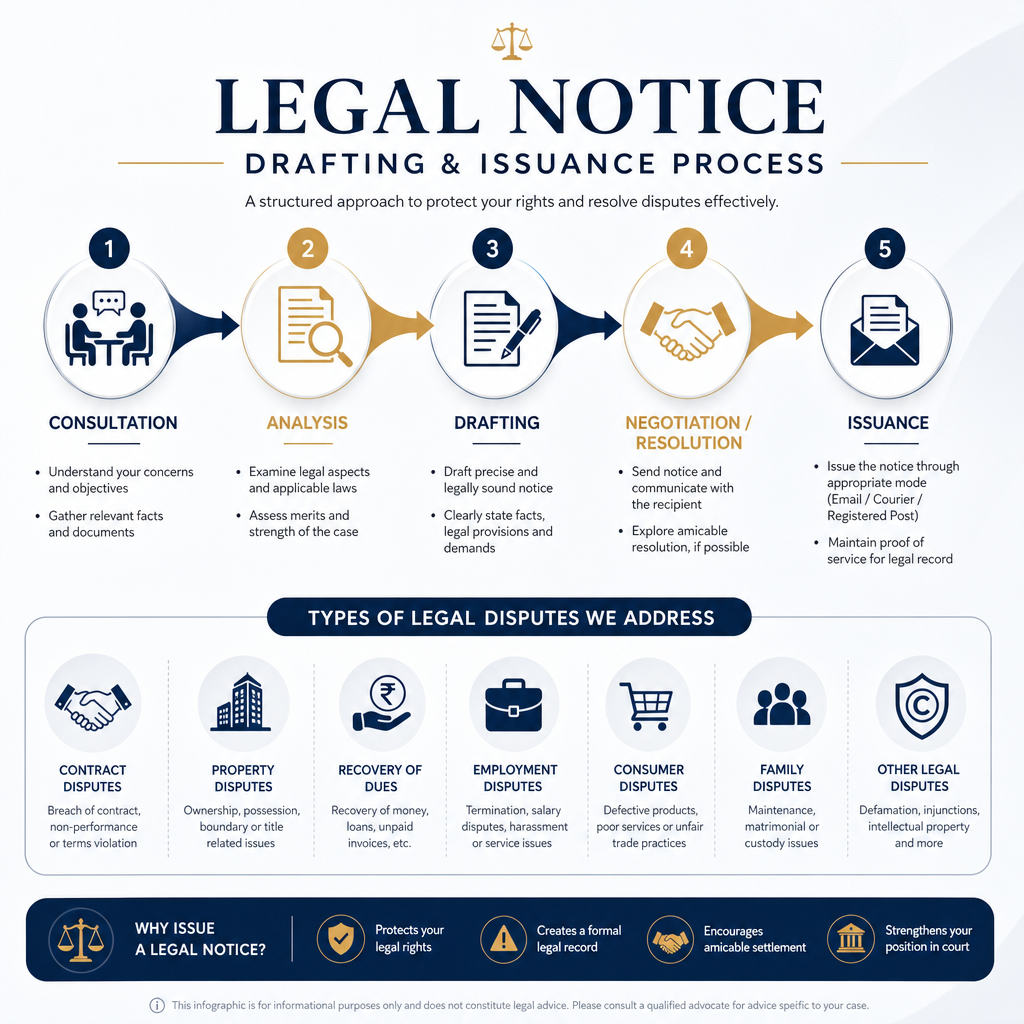
A legal notice can ask for reasons or correction of a bank service failure. It has no guaranteed deadline for releasing frozen funds, and a bank generally needs the proper authority’s direction or a court order before removing an externally imposed restriction. If fraud has just occurred, report it first; do not spend the crucial early hours waiting for a notice to be drafted.
Where LegalRecovery fits, and what to do next
LegalRecovery’s online process is designed for listed unpaid-money disputes, not for releasing a frozen bank account or securing the return of funds held by police. Its notice and escalation process, starting at ₹1,499, should not be presented as a substitute for a bank grievance, cybercrime investigation, or court application. You do not need to buy a money-recovery notice to begin the steps in this guide.
There may be a separate unpaid-money dispute behind your financial stress. For example, an employer who has not paid you is different from a bank blocking access to salary already credited. LegalRecovery covers unpaid salary and employment dues, but not removal of a bank freeze. The same distinction applies to a refund a seller owes you, a rental deposit a landlord has not returned, or an unpaid freelancer invoice. A seller’s frozen marketplace payout may fit its vendor and invoice recovery category; a bank-imposed account freeze does not. You can check the full service list before submitting a separate claim.
For the frozen account itself, keep your next steps simple: get the bank’s written reason, gather proof for the specific transaction, and approach the authority that can change the restriction. Report fresh fraud immediately. If the bank mishandles your complaint, use its grievance process and then the appropriate service-failure route. You may not control how quickly an investigation ends, but you can make sure your evidence and request reach the right people.
Popular Searches & Related Topics

Legal Recovery is India's trusted consumer protection and legal tech platform. We specialize in holding corporations accountable for unfair trade practices, deceptive marketing, and commercial fraud. With over 15,000 customers counselled, our mission is to provide fast, out-of-court resolutions by connecting you with top-tier panel advocates for immediate legal action.
Client Reviews
"My previous employer had not cleared my full and final dues. LegalRecovery helped me organise the details and send a clear legal notice. The employer responded and paid the outstanding amount. The process and updates were easy to follow."
Priya Sharma
"A coaching institute had delayed my refund despite several follow-ups. LegalRecovery helped me present the issue clearly and escalate it with a formal notice. I received the refund, and the team kept me informed throughout."
Rahul Mehta
"My landlord was not returning my rental security deposit after I moved out. LegalRecovery guided me through the notice process and helped me set out the amount and supporting records. I appreciated the straightforward communication, and the deposit was returned."
Sneha Iyer
"A client had left my freelance invoices unpaid for months. LegalRecovery helped me prepare a professional demand and follow up through the escalation process. The client settled the pending invoices, and I found the service practical and clear."
Arjun Patel
Frequently Asked Questions
Related Articles
About Author
Team LegalRecovery
View ProfileTeam LegalRecovery is a dedicated team of legal and financial professionals specializing in loan settlement, banking disputes, debt relief, and corporate compliance. We are committed to helping clients achieve debt freedom and business stability through expert strategic advisory.
Connect on LinkedInNeed Legal Help?
Get expert advice on loan settlement, banking disputes and debt relief.
Start Recovery NowRequest Callback