Doctor Not Getting Paid in India? How to Recover Your Dues
Whether you are owed salary, a training stipend or consultancy fees, learn how to document the shortfall and escalate.

Table of Contents
Table of Contents
Swipe →You may have finished your shifts, completed your internship duties or treated patients as a visiting consultant, yet the payment you were counting on has not arrived. That is stressful, especially when accounts keeps saying “next week” without giving you a date. You do not have to start with a court case. This guide will help you identify what you are owed, put the shortfall on record and choose the right next step for your situation.
First, work out what kind of payment is missing
Doctors are paid under different arrangements, and the route to recovery depends on yours. Check your appointment letter, training documents or consultancy agreement before describing the money as “salary”. The label on a payslip or invoice is useful, but the actual arrangement matters too.
If you are employed by a hospital or clinic
Your unpaid amount may be monthly salary, an agreed allowance or money due after you leave. Start with your employment documents and payslips. If the dispute concerns withheld salary or full-and-final dues, the unpaid salary and employment dues route is the relevant one. Do not assume that resigning makes the unpaid months disappear: record each month separately, including any partial payments.
If you are an intern or postgraduate trainee
Your missing payment is usually a stipend, not automatically an employee wage. An MBBS intern should identify the college’s applicable stipend rate and the relevant internship rules. A postgraduate resident should also check the rate applicable to their programme and state or Union Territory. Keep your joining and training records alongside proof that you performed the required work.
If you are a visiting consultant
Your hospital may owe professional fees under a consultancy agreement rather than salary. Gather the agreed fee terms, duty or procedure records and invoices. A consultant owed two accepted invoices of ₹75,000 each would normally begin with a claim for ₹1.5 lakh under those agreed terms. The independent professional payment route is more useful than treating every invoice as an employment-wage dispute.
Not sure which description fits? Write down who engaged you, who controls your schedule, how payment is calculated and what document records the agreement. That short summary will help an adviser assess the right claim without making you untangle every legal detail yourself.
Make the unpaid amount easy to check
You should not have to prove your case from memory while searching through months of messages. Create one simple ledger showing what became due, what reached your account and what remains. If the hospital says its records differ, ask it to identify the disputed entry in writing.
What to record | What to attach | Why it helps |
|---|---|---|
Each unpaid month or invoice, its due date and agreed amount | Appointment letter, stipend rate order, consultancy terms or invoice | Shows where the figure comes from |
Work completed during that period | Roster, attendance, internship log, training record or procedure record | Connects the payment request to work performed |
Every amount actually received | Payslips, bank entries and relevant TDS records | Prevents a partial payment being mistaken for full settlement |
Promises, objections or acknowledgements | Emails, messages and written replies from accounts or the dean | Shows what the institution accepts or disputes |
Your requests for payment | Dated email, letter and delivery acknowledgement | Shows when you raised the problem and what you asked for |
Your calculation can be modest: “April: ₹60,000 due, ₹20,000 received, ₹40,000 balance.” Repeat that for each period and total the balance. Separate any disputed extras from amounts the hospital clearly agreed to pay. If you are a trainee, attach the applicable institutional or government rate rather than a figure you found in another college’s case.
For example, in a particular dispute the Supreme Court directed Delhi’s Army College of Medical Sciences to pay an earlier batch of interns ₹25,000 per month, including arrears. Two unpaid months at that rate equal ₹50,000 for a person entitled under that order. It did not set ₹25,000 as the nationwide rate for interns. Using the correct rate makes your demand harder to dismiss.
Save complete copies of messages, not just screenshots with the sender and date cropped out. Keep originals where possible and make a separate folder for the ledger, supporting documents and correspondence. If your arrangement is invoice-based, this evidence checklist for unpaid professional work can help you spot gaps before sending a demand.
Which rules support your claim?
It is reasonable to want a rule you can point to. The important thing is to use the rule that fits your payment, rather than citing an employment provision for a training stipend or an independent invoice.
Salary owed to an employed doctor
The Code on Wages, 2019, effective from 21 November 2025, is the central starting point for an employment-wage claim where it applies. Section 17(1)(iv) sets the usual deadline for monthly wages at the seventh day of the following month. Section 17(2) provides for payment within two working days in cases of resignation and certain other specified exits. Sections 43 and 45 deal with responsibility for payment and wage claims.
Section 45(6) generally allows three years to file a wage claim. That is not a reason to wait: records become harder to obtain, and the employer’s explanation may change. If you are unsure whether a particular allowance or payment counts as a Code wage, have the terms checked before choosing the claims process. For a fuller walkthrough, see the steps for recovering unpaid salary.
Stipend owed to an intern or postgraduate resident
For MBBS interns, Schedule IV, clause 3 of the National Medical Commission’s Compulsory Rotatory Medical Internship Regulations, 2021 addresses stipends. For PG degree, diploma and super-specialty students, regulation 5.5 of the Post-Graduate Medical Education Regulations, 2023 requires stipends at par with applicable state or central government medical institutions in that state or Union Territory.
These rules give you a basis to question non-payment, but you still need to identify the rate that applies to you. Ask the college for its stipend order and payment record. If it relies on a different rate, ask it to explain that rate in writing. Request arrears for the unpaid period, not merely a promise that future stipends will arrive on time.
Fees owed to an independent consultant
Your agreement and proof of completed work are central. If the hospital breached agreed payment terms, section 73 of the Indian Contract Act, 1872 may be relevant to loss arising from that breach. Do not assume the Code’s wage-claim route or deadline applies to your professional-fee invoice. A lawyer can identify the appropriate civil claim and limitation period for your particular contract. For comparison, Article 7 of the Limitation Act, 1963 gives three years from when wages become due for a civil suit for wages; a fee claim needs its own assessment.
Visual Dispute Resolution & Recovery Framework
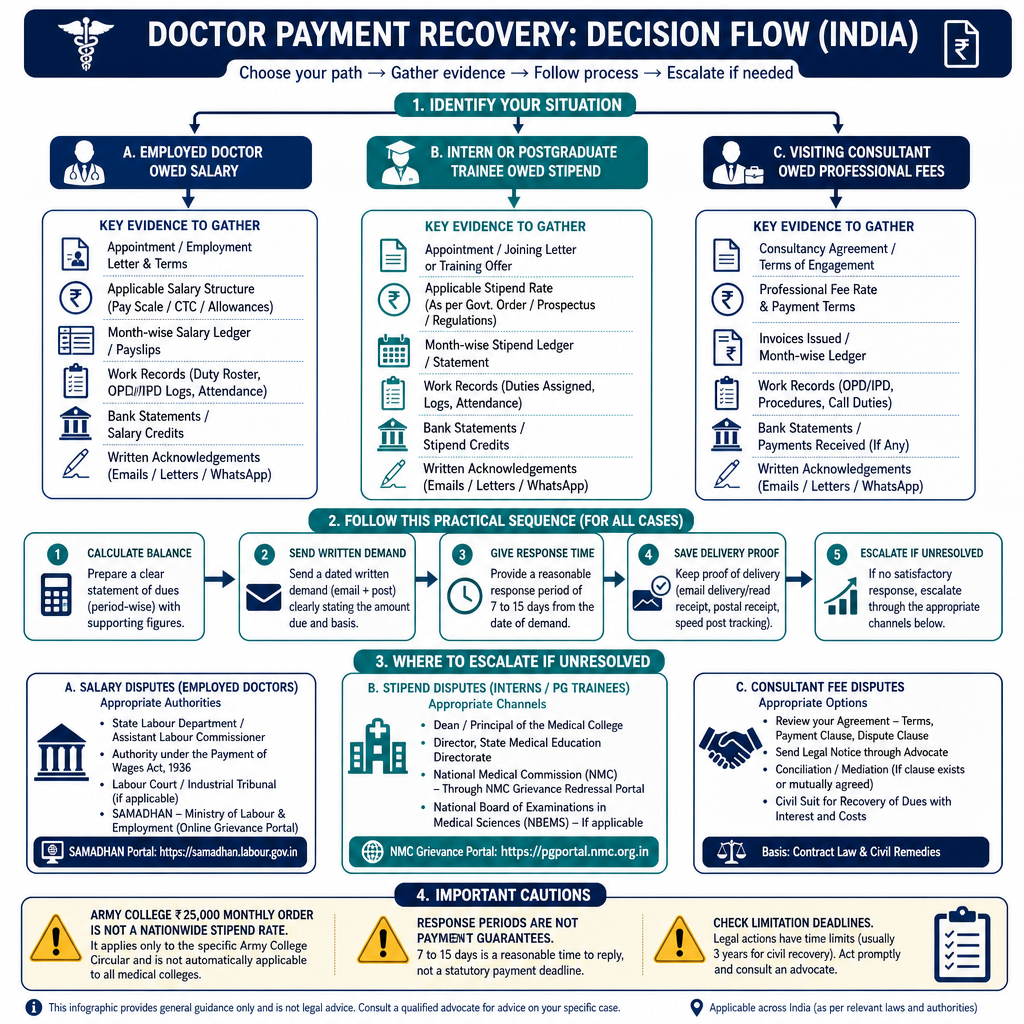
What should you send to the hospital this week?
Begin with a dated written demand to the person who can check the records: HR or accounts for salary, the dean and stipend office for training payments, or the hospital’s contracting and accounts teams for consultancy fees. A conversation may help, but follow it with an email so there is a clear record.
State your arrangement and period of work. Mention your role, department and the months or invoices affected.
Set out the calculation. List amount due, amount received and balance for each period. Attach the documents that establish the agreed rate.
Ask for a specific action. Request payment of the balance, or a written explanation of any disputed entry, and ask accounts to confirm the ledger in writing.
Give a reasonable response date. Seven to fifteen days is often practical for an initial demand. State the date clearly rather than saying “at the earliest”.
Keep proof of delivery. Save the sent email and acknowledgement, or the postal receipt and delivery record.
Keep the tone firm and factual. You can write, “My records show ₹40,000 outstanding for April and ₹60,000 for May. Please confirm the attached month-wise ledger and arrange payment by 15 October, or explain any discrepancy in writing.” If a colleague’s facts match yours, trainees may submit coordinated complaints, but each person should still have an individual calculation.
If someone offers a payment plan, get the amount and dates in writing. Check that it covers the entire outstanding balance, including earlier arrears. Do not mark a payment as “full and final” unless you are satisfied that it settles what you are owed. If accounts replies only with another vague promise, move to the next step instead of restarting the same conversation indefinitely.
Where can you escalate if the answer is silence?
Escalation is not one-size-fits-all. Choose the channel that matches your status and keep a copy of your original demand, ledger and reply, if any. A complaint is easier to assess when the person receiving it can see exactly what you already asked the institution to do.
For an employment-wage dispute
Approach the appropriate state labour department or wage-claims authority. The Ministry of Labour and Employment’s SAMADHAN portal also accepts delayed-payment grievances. Describe your employment arrangement and unpaid period accurately; the authority will need to assess whether your particular payment is an employment wage. Under section 45(2) of the Code on Wages, the authority should endeavour to decide a wage claim within three months and may award compensation. Three months is a statutory aim, not a reliable payment date for a contested case.
For a medical-college stipend
Escalate to the dean if you have not already done so, and copy the state Directorate of Medical Education. You can raise an NMC grievance through its complaint portal or at grievance@nmc.org.in. Attach the applicable stipend rule or rate order, training records and month-wise arrears. DNB, DrNB and FNB trainees can use the NBEMS grievance portal.
There is reason to document the issue carefully. In August 2025, the Supreme Court extended the Army College intern-stipend benefit to an earlier batch. In October 2025, it noted payments by some colleges while pressing NMC to act on continuing complaints. These developments show why sustained, well-supported escalation can matter; they do not mean every trainee is entitled to the same rate or result.
For public institutions or independent fees
If your grievance involves a public institution or regulator, CPGRAMS may be another route to seek a response. Its advised 21-day redress period, with reasons for delay, is a grievance-handling target, not a promise that your dues will be paid in 21 days. For consultancy fees, a contract-based demand and, if necessary, advice on a civil recovery claim may be more appropriate than a wage complaint.
A consumer commission is generally not the normal place to recover payment for medical work you supplied to a hospital: you are usually seeking money for your work, not complaining as a consumer of the hospital’s service. If one channel does not fit, that does not end your claim; it means you should choose the correct route before more time passes.
Would a legal notice help?
A legal notice puts the payment request in a formal, organised form. It can be useful when the hospital has ignored a clear demand, disputes an amount without explaining why, or repeatedly promises payment without following through. It should identify the parties, the basis for payment, the calculation, supporting documents, what you want paid and a reasonable response deadline.
You can read more about sending a legal notice online before deciding whether it is worthwhile. A notice can prompt a serious review or settlement discussion, but it cannot force an immediate reply, and there is no guaranteed time for payment. If the recipient contests the contract or your entitlement, further steps may be necessary.
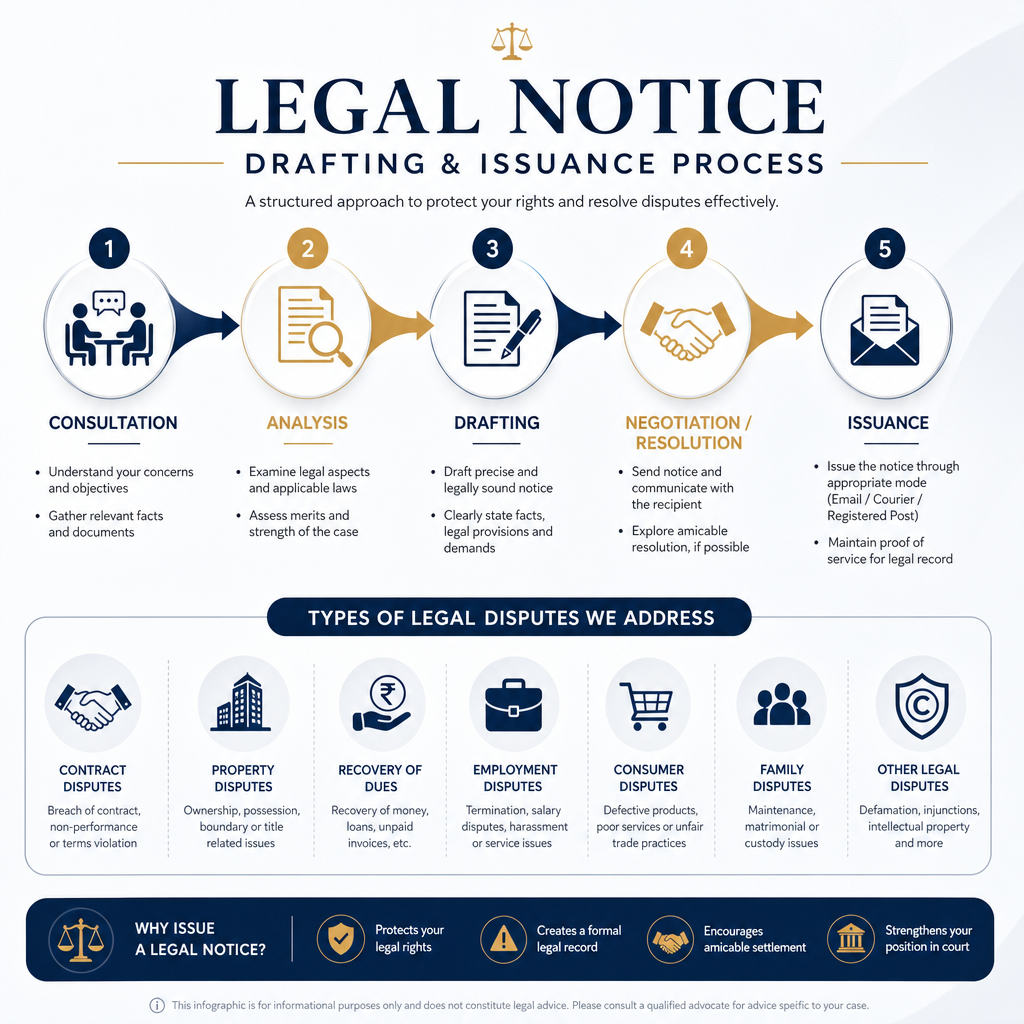
LegalRecovery can help organise this stage online. Its process begins when you submit your case, followed by review by legal experts, drafting and dispatch of a professional notice by registered post, multi-channel follow-up and escalation, and work towards resolution. The service starts at a ₹1,499 flat fee. Its five-step process may suit a doctor who wants help pursuing unpaid salary or professional fees without making visits just to manage the notice process. If a dispute ultimately requires court proceedings, do not take “online case management” to mean that a court appearance can never be required.
How long should you keep trying, and what do you do next?
There is no honest universal recovery timeline. A corrected accounts entry may be paid quickly; a disputed stipend rate or consultancy contract can take longer. The useful question is whether each step is producing something concrete: payment, a written acceptance of the balance, a dated payment schedule or a specific explanation you can answer.
Give your initial written demand its stated response period, often seven to fifteen days. If nothing credible follows, use the relevant grievance or claims channel, consider a notice, and keep track of filing deadlines. Do not mistake the wage authority’s three-month endeavour or CPGRAMS’s 21-day grievance target for a guarantee. Nor should you let repeated informal assurances carry you close to a limitation deadline.
If the hospital pays only part, update your ledger, acknowledge the amount received and continue to seek the remaining balance. If it says you were absent, the rate was lower or an invoice was rejected, ask for the records behind that position and compare them with your roster, agreement and correspondence. A precise answer is more useful than another broad accusation of non-payment.
Start today with one folder and one month-wise calculation. Send it to the right office, save proof it arrived and put a reminder against your response deadline. If that deadline passes without payment or a workable written plan, you will have the documents needed to escalate. Your first step does not have to solve the whole dispute; it just has to turn an unexplained shortfall into a clear, supportable claim.
Popular Searches & Related Topics

Legal Recovery is India's trusted consumer protection and legal tech platform. We specialize in holding corporations accountable for unfair trade practices, deceptive marketing, and commercial fraud. With over 15,000 customers counselled, our mission is to provide fast, out-of-court resolutions by connecting you with top-tier panel advocates for immediate legal action.
Client Reviews
"My hospital had delayed part of my salary and kept giving me unclear updates. LegalRecovery helped organise the payment details and prepare a formal notice. The process and next steps were explained clearly, which made it easier to follow up professionally."
Ananya Sharma
"I was owed consultancy fees for completed hospital work. LegalRecovery helped present my agreement, invoices and outstanding amount in a clear notice. I appreciated the responsive communication and having a structured way to pursue the payment."
Rahul Menon
"My final salary dues were still pending after I left my employer. LegalRecovery helped me put the calculation and supporting records in order and sent a formal notice. The service made the follow-up feel more organised and less stressful."
Meera Iyer
"I had unpaid professional invoices and was unsure how to make a clear written demand. LegalRecovery reviewed the details I provided and helped with the notice and follow-up process. I valued the practical guidance and regular updates."
Arjun Kulkarni
Frequently Asked Questions
Related Articles
About Author
Team LegalRecovery
View ProfileTeam LegalRecovery is a dedicated team of legal and financial professionals specializing in loan settlement, banking disputes, debt relief, and corporate compliance. We are committed to helping clients achieve debt freedom and business stability through expert strategic advisory.
Connect on LinkedInNeed Legal Help?
Get expert advice on loan settlement, banking disputes and debt relief.
Start Recovery NowRequest Callback