Boss Is Not Paying Salary? What Should I Do in India?
Know how to document unpaid wages, make a written demand, and approach the right labour authority.

Table of Contents
Table of Contents
Swipe →When your salary does not arrive, every bill can suddenly feel urgent. It is especially frustrating when your boss says “next week” but gives you nothing in writing. You do not need to know legal jargon to take the first step. This guide will help you work out what you are owed, ask for it clearly, and approach the right labour authority if your employer still does not pay.
First, turn the missing salary into a clear amount
Before arguing about why payment is delayed, pin down exactly what has not been paid. Was it one month’s salary, several months, your last salary after leaving, or a deduction you cannot explain? A precise figure is easier for HR to check and harder for an employer to dismiss with a vague promise.
Make a month-by-month calculation
List the pay agreed for each month, any deductions shown on your payslip, what actually reached your account, and the balance. For example, two unpaid months at ₹20,000 each would mean a ₹40,000 claim if there are no applicable deductions or payments to account for. Keep disputed deductions in a separate column rather than quietly accepting them.
If your employer says the client has not paid, ask for your salary payment date anyway. A client’s delay does not, by itself, establish that your wages can be withheld. If the explanation is a pending “full and final” settlement, ask which components are pending and for an itemised statement. You can address the reason they give without losing sight of the basic question: what is due, and when will it be paid?
If this is your first missed payday, start with a calm email to HR and your reporting manager. State the month, amount and expected payday, attach your calculation, and request a definite payment date. Save the email and any reply. You are creating a useful record, not starting a fight.
The documents you need before you do anything else
You may not have a perfect employment file, and that is okay. A combination of ordinary records can show your agreed pay, the work you did, and the missing payment. Save copies somewhere you can access if your work email or company account is later disabled. Keep original files where possible, and avoid changing screenshots or message histories.
What to keep | What it helps show |
|---|---|
Offer or appointment letter, contract, pay-revision emails | Your employer, pay terms and agreed salary |
Payslips and bank statements | Earlier salary pattern, stated deductions and missing credits |
Attendance, shift rosters, work emails or deliverables | That you worked during the unpaid period |
HR chats, emails and payment promises | What the employer acknowledged or disputed |
Resignation, handover and settlement correspondence | Dates and dues if you have left the job |
Your demands and delivery records | What you requested and when the employer received it |
In your calculation, use a row for each unpaid month and columns for gross pay, deductions, amount received and balance due. If a deduction is disputed, note what the employer called it and ask for its basis in writing. Do not guess at tax or other figures you cannot verify. Your table can be corrected when the employer produces its records.
What if most conversations happened on WhatsApp?
Keep the whole relevant conversation, including dates, phone numbers and the messages around any promise to pay. Screenshots are useful, but the original chat and its context are better than a cropped line saying “will do.” Follow up an important call or chat by email: “As discussed today, you said my May salary of ₹20,000 would be paid by Friday. Please confirm.” If they do not confirm, your email still records what you asked.
If you worked through a contractor, record the contractor’s legal name and the organisation where you worked. Keep site passes, rosters or messages that connect you to that workplace. Those details can matter when you identify whom to approach about unpaid wages.
Finally, do not sign an acknowledgement saying “full and final paid” if the money has not reached you. If you are asked to sign paperwork to release a payment, read it carefully and ask for a copy. An inaccurate receipt may create an avoidable dispute about whether you were already paid.
What does Indian law say about late salary?
A delayed payday is not something you have to treat as an unlimited favour from your employer. The main current law to discuss with a labour officer is the Code on Wages, 2019, brought into force from 21 November 2025. You may still find older guides pointing to the Payment of Wages Act, 1936 as the current claim route, so check that advice before relying on it.
Paydays, exit payments and deductions
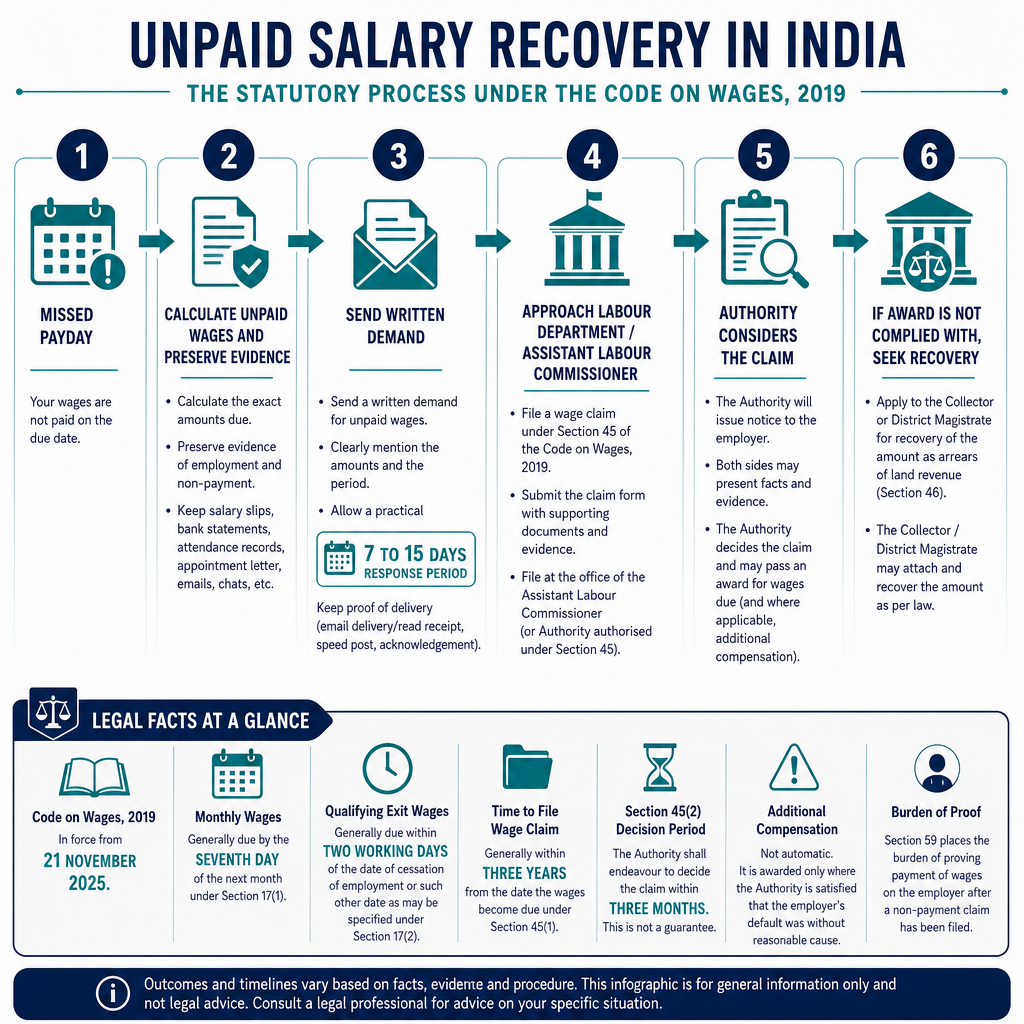
Under section 17(1) of the Code, monthly wages are generally payable by the seventh day of the following month. Section 17(2) provides for wages payable on resignation, dismissal or retrenchment to be paid within two working days, subject to the qualifications in subsections (3) and (4). If you have left, identify your last working day and ask the employer to explain each unpaid component separately. For a closer look at exit dues, see this guide to recovering full-and-final settlement.
Section 18 restricts deductions from wages. That does not mean every deduction is unlawful; it means your employer should be able to identify and justify what was deducted. Request a payslip and written breakup rather than trying to settle an unexplained shortfall over a phone call.
You can make a formal wage claim
Section 45 provides for a claim before an authority appointed by the appropriate government. The claim is generally to be filed within three years, so do not let repeated “next month” promises consume your time. The authority can order payment and may award additional compensation, but compensation is not automatic. Once a non-payment claim is filed, section 59 places the burden of proving payment on the employer. Your own records still matter: they help establish what you are claiming and why.
These rules are a way to frame your request, not a reason to send HR a page of legal quotations. Your first message can stay simple. If you need a fuller explanation of the route, read the steps to recover unpaid salary from an employer.
Visual Dispute Resolution & Recovery Framework
Ask for payment in writing, then set a sensible deadline
If your payday has passed and the first email has not resolved it, send a written demand to HR and the employer. Email is useful because it is quick; a delivery-trackable method gives you another record of receipt. Use the address shown in your appointment documents or other reliable company records, and keep copies of everything sent.
What should your demand say?
Identify yourself, your role, the workplace and your employment dates.
State each unpaid month or settlement component and the amount claimed. Attach your calculation.
Mention payments already received, if any, so your balance is accurate.
Ask for the payment date and a written explanation of any disputed deduction.
Give a reasonable response deadline, such as 7 to 15 days, and state that you will approach the labour authority if the issue remains unresolved.
For example: “My salary for April and May remains unpaid. At ₹20,000 per month, the outstanding amount is ₹40,000, subject to the attached breakup. Please pay the balance or send an itemised explanation of any disagreement within 10 days.” Adjust the figures to your records. Do not add threats you do not understand or claim that a deadline automatically creates a penalty.
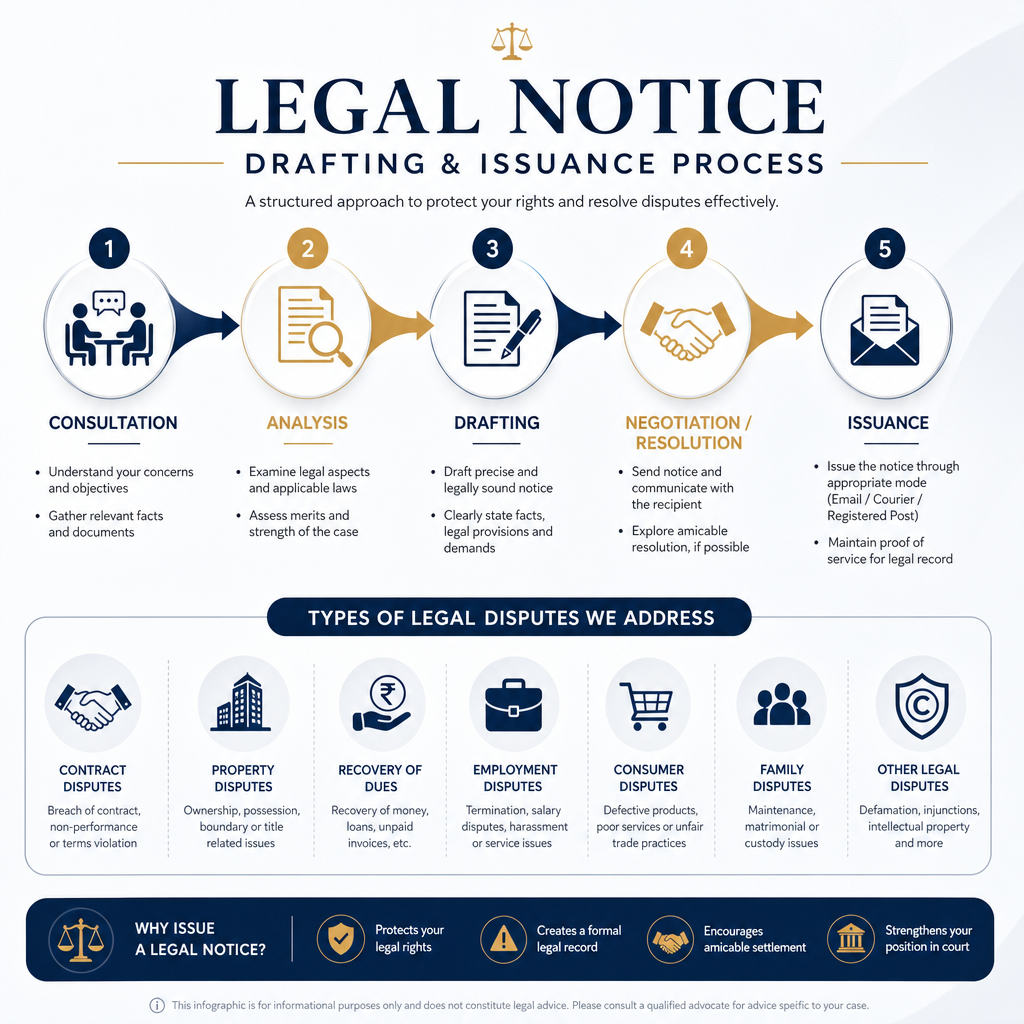
A lawyer’s notice is an option, not a compulsory first step. It can help if the employer denies your employment, disputes the calculation or ignores a clear demand. If you want professional help with this stage, LegalRecovery’s unpaid salary and employment dues service covers salary and withheld exit payments. Its process starts with online case submission and expert review, followed by a drafted notice sent by registered post and follow-up. Pricing starts at ₹1,499 flat fee. You can also read how a salary legal notice works before deciding whether it is worth the cost.
A notice may prompt payment or clarify the dispute, but neither paying for a notice nor setting a deadline guarantees recovery. If the employer stays silent, move on to the claim route rather than sending the same request indefinitely.
Where should you complain if they still do not pay?
You do not need to choose between doing nothing and starting a complex court case. Your practical next stop is usually the state labour department or local Assistant Labour Commissioner for your place of work. Take your calculation, employment records, bank statements, demands and proof of delivery. Explain which wages are unpaid and ask how to file before the authority appointed for a section 45 wage claim.
Make sure you reach the claim route
A grievance acknowledgement can be useful, but it is not the same as having your wage claim heard. Ask the dealing officer what form or process applies, which office has jurisdiction, how the employer will be notified, and how you can track the matter. Keep your acknowledgement or claim number and a copy of every document submitted.
The central labour ministry’s SAMADHAN portal accepts complaints about delayed payment and unauthorised deductions. Some of its online guidance still mentions laws from before the Code on Wages came into force. If you use the portal, confirm with the dealing officer whether you also need to file, or pursue, a section 45 claim through the appropriate authority. For a walkthrough of the options, see how to recover unpaid salary legally.
Under section 45(2), the authority should endeavour to decide a claim within three months. That is a target, not a guaranteed date for money in your account. A disputed calculation, difficulty serving the employer or later recovery steps can take longer. If an employer does not comply with an award, section 45(3) provides for recovery through the Collector or District Magistrate. Ask the authority how to seek that step instead of assuming an unpaid award is the end of the road.
If you need help preparing the papers, contact your District Legal Services Authority through NALSA or call 15100. Free legal aid depends on the applicable eligibility category or income limit. An ordinary unpaid-salary dispute with a private employer is not normally a consumer-forum complaint, so the labour route is the more useful place to start.
Does your situation change the route?
Some employers use different labels for the same problem: “settlement pending,” “contractor issue” or “salary adjusted.” The label should prompt a more precise question, not make you give up your claim.
If you resigned or were dismissed
Ask for an itemised full-and-final statement showing salary for days worked, payments made and every proposed adjustment. Keep your resignation, acceptance and handover records. If the employer says notice-period salary was withheld or adjusted, ask them to identify the agreed term and their calculation. A disagreement over one item does not make an unexplained balance clear. This guide to withheld notice-period salary may help you organise the questions to ask.
If a contractor hired you
Put both the contractor and the organisation where you worked in your notes. For covered contract labour, section 55(3) of the Occupational Safety, Health and Working Conditions Code, 2020 makes the principal employer liable for wages the contractor fails to pay. Tell the labour officer who supervised your work and where it was performed, and provide records linking you to the site. Do not accept “the contractor disappeared” as the complete answer without checking this route.
If your employer is a government establishment
Ask your department about the applicable service rules and departmental remedy. Section 25 of the Code on Wages limits application of its payment-of-wages chapter to government establishments unless notified, so the private-employer route may not fit your case. CPGRAMS can help you raise inaction by a government department, but it is a grievance channel, not a wage-recovery court.
A Rajasthan High Court decision, Sunil Dattatrey v. State of Rajasthan, ordered payment in February 2025 after a state employee went 97 months without salary. It shows that a long delay can be challenged, but a public-employer ruling is not a promise of the same remedy or speed against a private company.
How long might this take, and what should you do this week?
It is reasonable to want a date you can plan around. Unfortunately, no notice, portal or complaint can guarantee one. Early written requests sometimes resolve a payroll error; disputed dues can take longer. Recorded SAMADHAN cases show that labour-officer intervention has led to settlements, including complaints covering seven contract employees and ₹5.91 lakh in unpaid wages for January to June 2024. Those results show what is possible, not what every worker will receive.
Give yourself a short, manageable plan:
Today: check your bank statement and payslip, calculate the unpaid balance, and save your employment and work records.
Next: email HR and the employer with the amount and a request for a firm payment date.
If unresolved: send an itemised written demand with a 7-to-15-day response period and keep delivery proof.
If the deadline passes: contact the labour department about a section 45 claim. Do not wait through months of unsupported promises, especially with the filing period in mind.
If you prefer help preparing and following up on a notice, LegalRecovery explains its online review, notice and escalation process. Its notice and case-management stages do not require a court visit; a later formal proceeding may still require your participation. Whether you use a service or handle the first demand yourself, the most valuable move is the same: put the amount, evidence and request in writing, then follow through if payment does not arrive.
Popular Searches & Related Topics

Legal Recovery is India's trusted consumer protection and legal tech platform. We specialize in holding corporations accountable for unfair trade practices, deceptive marketing, and commercial fraud. With over 15,000 customers counselled, our mission is to provide fast, out-of-court resolutions by connecting you with top-tier panel advocates for immediate legal action.
Client Reviews
"My previous employer had held back two months of salary after I left. LegalRecovery helped organise my documents and sent a clear legal notice. The company responded and paid the outstanding amount. I appreciated the practical updates throughout."
Amit Verma
"HR kept postponing payment of my final salary without giving me a proper breakup. LegalRecovery reviewed my records, prepared a notice and followed up with the employer. The dues were cleared, and I finally had the issue documented properly."
Priya Nair
"I was unsure how to claim salary withheld during my notice period. The LegalRecovery team helped me present the amount and supporting records clearly, then sent a formal notice. It helped get a response from the employer and resolve the payment dispute."
Rahul Mehta
"My employer said my unpaid wages were delayed because its client had not paid. LegalRecovery helped me set out the salary due and send a professional demand notice. The employer got back to me and paid the arrears. The process was straightforward and reassuring."
Sneha Iyer
Frequently Asked Questions
Related Articles
About Author
Team LegalRecovery
View ProfileTeam LegalRecovery is a dedicated team of legal and financial professionals specializing in loan settlement, banking disputes, debt relief, and corporate compliance. We are committed to helping clients achieve debt freedom and business stability through expert strategic advisory.
Connect on LinkedInNeed Legal Help?
Get expert advice on loan settlement, banking disputes and debt relief.
Start Recovery NowRequest Callback